
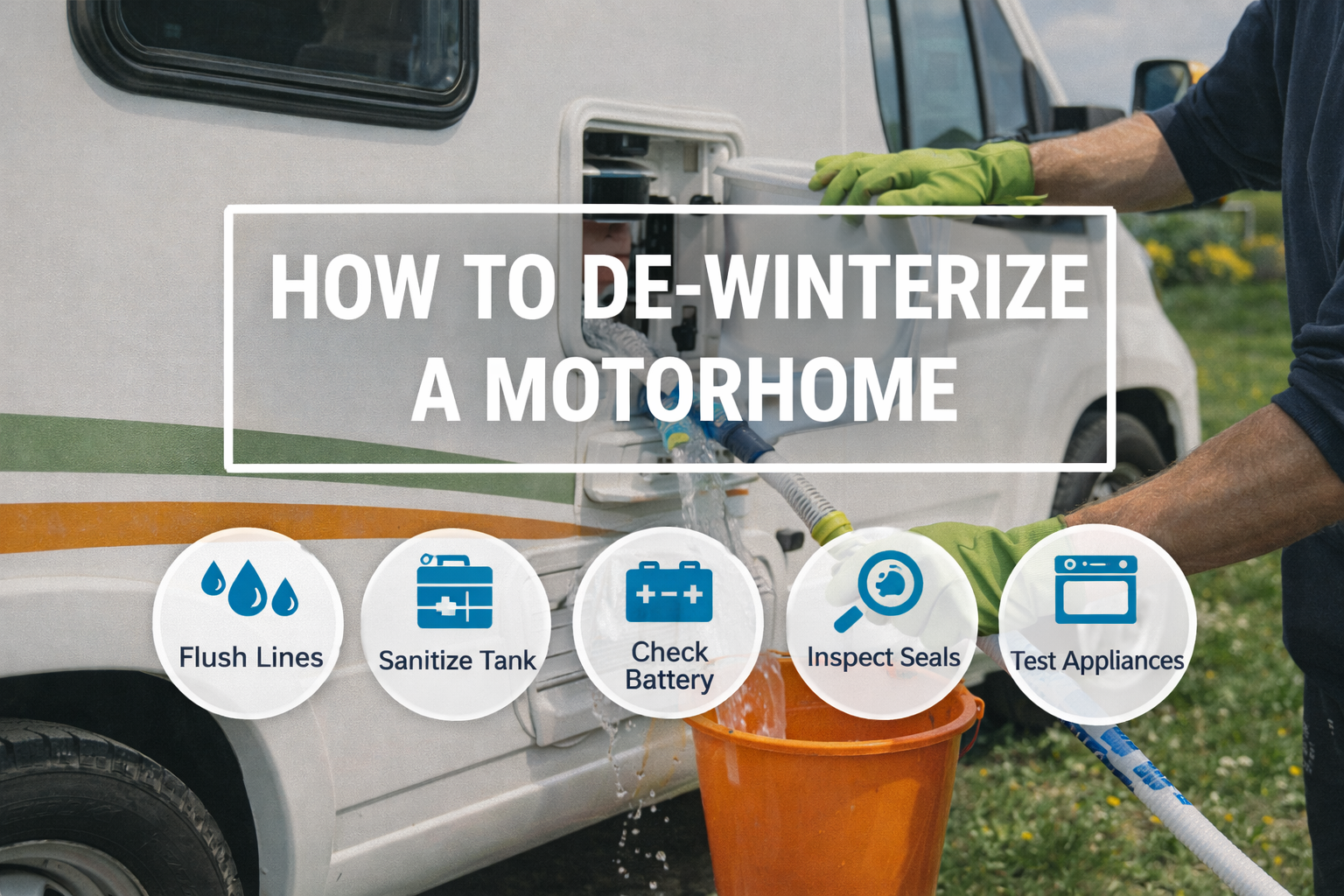
De-winterizing a motorhome is when you return a stored RV to a safe, reliable unit for the spring camping season. It matters because your first trip of the season often exposes problems that stayed hidden during winter storage, especially damp from tiny seal failures, flat or underinflated tyres, tired rv batteries, and skipped gas or electrical checks.
In the UK, those “first-use” failures show up fast because spring weather swings, humidity, and early EHU use can stress your systems all at once.
It also protects your investment. A motorhome that has a documented “season-ready” check, plus receipts for resealing, filter changes, and habitation-style checks, looks lower-risk to buyers and better retain its long-term value.
That reduces negotiation pressure when you sell your motorhome, and it supports a stronger asking price with motorhome traders and dealers who scrutinise damp history, maintenance records, and safety devices..
You can view de-winterizing as a set of categories in a practical order:
- Exterior/roof/underbelly inspection and spring cleaning
- Tyres and brakes (pressure, tread, age, torque)
- Batteries (house + chassis) and charging checks
- Fresh-water flush and sanitise (water tank, water lines, water heater)
- Leak checks on plumbing system and holding tanks
- LPG propane system and propane appliances tests
- 230V/12V electrics (EHU, RCD, outlets, converter)
- Engine/chassis fluids and basic roadworthiness
- Generator load test and rv generator condition
- Solar panels and controller checks
- Filters and HVAC/furnace checks
- Slide outs and awnings function and seal care
- Pests and entry-point sealing
- Tow setup (if you tow)
- Safety kit, documents, and a shakedown drive
Why should you de-winterize a motorhome before your first spring trip?
You should de-winterize a motorhome before your first spring trip because it prevents avoidable breakdowns and reduces safety risks that come from stored systems being put back under real pressure and load.
Storage changes tyre pressure, battery condition, and water quality even if the motorhome looks fine from the outside.
When you reconnect a city water connection, pressurise the RV water system, and switch on appliances, minor issues turn into leaks, faults, or complete failures.
Underinflated RV tyres reduce handling and raise heat build-up, especially on heavier models and class B conversions that remain on the same contact patch for long periods.
Stale or contaminated fresh water and a neglected plumbing system can leave bacteria, odours, and antifreeze taste that ruin your first camping trip.
Unchecked propane leaks and untested electrics raise incident risk, especially when your first night relies on EHU and you suddenly run a kettle, charger, and heater together.
It also prevents damage that buyers notice. Catching cracked sealant on roof seams early helps you avoid water ingress, mould, and delamination, which are costly and commonly flagged in UK-style damp inspections.
Keeping a clear record of spring commissioning protects your motorhome’s value and lowers the “what else was missed?” discount buyers and traders apply.
When should you de-winterize a motorhome?
You should de-winterize your motorhome when overnight temperatures are consistently above freezing, because refilled water lines and tanks can re-freeze if you get a cold snap after you put the system back into service.
The temperature rule matters more than the calendar, as a single frosty night can crack fittings, distort valve bodies, or turn a slow leak into damp behind cabinets.
Plan it as a half-day job at minimum, and longer if you have slide outs, solar panels, a generator, or a complex plumbing layout. Choose a dry weather window to safely inspect the roof, clean seams, and apply sealant with adequate cure time. Use an extended forecast, not just tomorrow’s weather, because the risky moment is right after you refill and bring the water heater out of bypass mode.
Plan to finish 24–48 hours before departure. That buffer gives you time to fix leaks, condition a battery properly, replace filters, and do a short shakedown so your first camping season drive is a test you control, not a problem you discover at the gate.
How do you de-winterize a motorhome step by step?
De-winterizing reverses your winterization process (rv antifreeze vs air compressor blowout) and then proves each safety-critical system under real load: water pressure, LPG pressure, electrical load, generator load, and driving load. This how-to uses 20 steps, so you can work in order, tick items off, and build a clean record for your manual and service file.
Step 1: How should you inspect the exterior body, roof, and underbelly?
Start by walking the exterior slowly and treating it like an inspection, not a quick look. You are searching for water damage clues, cracks in sealant, and openings that let damp or pests into the unit during winter storage. Use a stable ladder, a flashlight, roof-safe footwear, and a plastic scraper for any loose sealant you need to remove later. If the motorhome was stored outside, assume snow and water-load stress worked on roof seams and penetrations, even if you never saw standing water.
On the roof, check seams, edge trim, vents, skylights, aerials, and the A/C shroud for cracks around fasteners. On the body, scan windows, doors, locker frames, and slide-out corners for staining, mildew lines, and soft spots that suggest slow ingress. Underneath, look at underbelly panels for tears or missing fasteners, then check for dangling ducts, exposed wiring, and damaged tank fittings or valve housings.
Take dated photos of defects before and after any repair. Traders, dealers, and serious buyers treat roof and seam care as a primary damp-risk indicator, so evidence of proactive work supports stronger sales discussions later.
Roof, seams, and sealants — what do you check?
Identify your roof material (EPDM, TPO, fibreglass) because compatibility matters for any roof sealant or cleaner you use. Focus on lap sealant around penetrations and along edge trim, since UV exposure can cause chalking, micro-cracks, and lifting edges. Run your fingers along seams to feel for gaps, brittle spots, or areas where sealant has separated from the surface.
If sealant is loose or peeling, remove only the failed material with a plastic scraper, clean the bonding area, and reapply a compatible product rather than stacking random sealants. A gentle roof clean and seam inspection several times per year is common practice, especially after storms or long storage, because seams fail gradually before they fail visibly.
This step links directly to motorhome value. During habitation-style checks, clean seams and recent reseal receipts reduce buyer risk perception and limit price renegotiation tied to damp.
Windows, air vents, and skylights — where do leaks start?
Leaks often start at gaskets, trim rails, and fasteners that loosen with temperature cycles. Check window seals for brittleness, confirm weep holes are clear, and look for wall discolouration or subtle yellowing around openings, since that can be an early damp sign. Inspect roof vent lids and vent frames for hairline cracks, and check skylights for crazing that spreads over winter.
Tighten hardware carefully where appropriate, but don’t over-torque and deform frames. Make sure interior trim rings are snug, because loose trim can hide seepage until it becomes a larger issue behind cabinets. If a seal feels hard or cracked, plan a gasket replacement rather than relying on surface sealant alone.
Underbelly panels and tank fittings — what’s critical?
Underbelly damage is both a leak risk and a pest entry route, so check coroplast or metal panels for abrasions, missing fasteners, and open seams. Look for “wet dust” trails that suggest a slow drip from drains, pump connections, or low-point drains once you re-pressurise later. Pay extra attention to holding-tank outlet areas, gate valve housings, and any fittings that could show freeze stress as cracking or distortion.
Scan plumbing components near exposed runs for rubbed-through insulation, loose pipe supports, and anything that could chafe while driving. If you see dangling wiring or ducts, secure them now, because vibration on the first road run can turn a small issue into a failure. This check also prepares you for later leak diagnosis, since you’ll already know what “normal” looks like.
How do you wash and protect the exterior?
Wash the exterior with a gentle method that removes road film and winter grime without forcing water into seals. Avoid high-pressure spray near windows, seams, vents, and marker lights, because pressure can drive water past aging gaskets. Use a dedicated cleaner for black streaks, then protect the finish with an appropriate wax or sealant based on the surface type (gelcoat vs painted panels).
Oxidation is common after storage, so polishing dull areas improves appearance and makes future inspection easier because you can spot new staining faster. Apply wax or sealant at least a couple of times per year if the motorhome spends time outside, since that slows oxidation and preserves the look of doors, lockers, and roofline edges.
This is not just cosmetic. Clean presentation and tidy seals build confidence on viewing day, and that confidence supports firmer offers from dealers or motorhome trader buyers who compare multiple units back-to-back.
Step 2: How do you check and service motorhome tires properly?
Start tyre work before any long road test, because tyre condition is a known contributor in road-safety datasets and it’s one of the easiest spring failures to prevent. Check cold psi against the placard and load ratings, not guesswork, and confirm each tyre matches the motorhome’s actual loading. During storage, tyres commonly lose about 1–3 psi per month, and cold outdoor weather can worsen that loss, so underinflation is the default risk.
Inspect tread depth and use a quick coin-style tread check as a fast screening tool, then measure properly if anything looks borderline. Check sidewalls for weathering, small cracks, bulges, punctures, and valve stem condition. Read DOT date codes and treat tyres older than 6–7 years as replacement candidates, with closer inspection once you pass 5 years, even if tread looks fine.
Torque wheel nuts to the correct spec, and do a basic brake peek where access allows. If the motorhome sat on the same patch, watch for flat-spot symptoms on the first drive, such as a rhythmic thump, vibration, or vague handling. If you run TPMS, confirm it alerts correctly by verifying sensor reporting before you rely on it for the season.
Step 3: How do you charge, reinstall, and test house and chassis batteries?
Charge and test your battery systems before you depend on them, because voltage readings alone can look “fine” while the battery cannot deliver current for slide outs, pumps, or ignition. Use a smart charger that matches your battery type, clean terminals, and apply a light dielectric protectant to reduce corrosion. When reinstalling, follow safe order: connect positive first, then negative, and keep jewellery off your hands to prevent accidental shorts.
After charging and resting, check voltage. A healthy fully charged 12V battery typically reads about 12.6–12.8V at rest, while around 12.0V or below indicates it needs charging before use. Batteries self-discharge monthly in storage, so spring battery neglect often shows up as dim lights, slow cranking, or nuisance faults on control panels.
If you have flooded batteries, check battery fluid levels safely. Wear gloves and eye protection, use distilled water, and keep plates covered; add water before charging if plates are exposed. Expect charging to take hours to days depending on capacity and how deep the discharge was. Finish with a load test, because the ability to hold voltage under load is what matters when you run a water pump, slides, or levelling systems, not just the number on a meter.
Step 4: How do you flush the freshwater and plumbing system?
Flushing restores safe, usable water in your fresh water tank and clears out anything left from winterization, including antifreeze, trapped air, and stale water. Return bypass valves to normal, reinstall drain plugs or an anode rod where applicable, and confirm the water heater is ready for service but do not heat it while empty. If you used an air compressor blowout method, flushing still matters because you may have residual tastes and debris in the lines, even if you did not use much rv antifreeze.
Connect a regulated city water connection using a proper hose, then run each faucet until water runs clear with no pink tint, bubbles, or odd smell. Work methodically through the water system: kitchen, bathroom, shower, outdoor shower, toilet, and any often-missed outlets like washer or ice maker lines where fitted. Use low-point drains, if installed, to speed removal of trapped water and to clear pockets in water lines and pipes.
If taste persists, a baking-soda rinse through the plumbing system followed by another flush can reduce lingering antifreeze taste. Empty grey and black holding tanks at authorised disposal points, and handle any drained solution responsibly. If your water heater was not bypassed during winter, drain and flush it, inspect the anode rod for heavy corrosion, and replace it if needed before you put the system under heat.
Step 5: How do you sanitize the freshwater system effectively?
Sanitising your rv water system removes bacteria and odours that develop in stored tanks, and it makes your first camping trip feel normal instead of “plastic and chlorine.” A common mix is 1/4 cup unscented household bleach diluted in water per 15 US gallons of tank capacity, which is about 57 litres, and this typically yields roughly 50 ppm residual chlorine when distributed through the system. A stronger approach can use about 1/2 cup per 15 gallons to reach closer to 100 ppm, which can reduce contact time, but you still need thorough flushing afterwards.
Mix the solution first in a container, pour it into the fresh water tank, top up with fresh water, then circulate it through every faucet and outlet until you smell chlorine. Remove or bypass carbon filters before sanitising so you don’t damage filter media or trap the solution. Let it sit for 4–12 hours for standard strength, or about an hour minimum for a stronger mix, then drain and flush until odour disappears.
Do not leave chlorine solution in lines beyond the recommended window unless your manual specifies it, because extended exposure can accelerate synthetic seal wear. Once flushed, reinstall or replace water filter cartridges per instructions, since fresh filters improve taste and protect the water pump and fixtures on your first run.
Step 6: How do you check for plumbing leaks after pressurizing?
Pressurise your plumbing system and verify it holds pressure, because spring leaks often appear at fittings only after the water lines return to normal operating pressure. Test using both the onboard water pump and a city water connection, since each can reveal different issues. After pressurising, the pump should shut off; if it repeatedly cycles with all taps closed, suspect a leak or a failed check valve.
Open every access panel and check each joint with a dry paper towel, including areas behind cabinets and inside pass-through storage. Look at PEX connections, pump head fittings, the water heater area, toilet valves, and low-point drains. Even a slow weep matters, because trapped moisture becomes damp, then staining, then a buyer’s reason to discount your unit.
Check waste systems too. Add a small amount of water to grey and black systems, then inspect dump valve bodies and fittings for drips to confirm valves seal correctly. Fixing a clamp or reseating a connection now is cheaper than chasing water damage later.
Step 7: How do you inspect and service the propane (LP) system?
Treat the propane system as a safety system first, not a comfort upgrade, because a small leak or blocked vent can turn into a serious issue on your first night. Start by confirming the cylinder or tank level, then check the certification date if your setup uses refillable bottles that require periodic testing. Inspect pigtails, hose runs, and the regulator body for cracking, stiffness, or chafe marks, and make sure the regulator vent faces downward so it can breathe and shed moisture.
Open valves slowly. Rapid opening can trigger an excess-flow device and leave you thinking there’s a fault when it’s actually a safety shutoff. Do a basic leak check with a soapy solution on connections and joints, watching for growing bubbles that indicate a leak, and tighten or reseat fittings only if you are confident and working within your manual guidance. If you want a higher-confidence result, a professional manometer drop test is the gold standard for proving tightness.
Before you light anything, check appliance vents and exhaust outlets for debris, spider webs, or insect nests, especially around the fridge, water heater, and furnace. If you smell LPG at any point, shut off the gas, ensure appliance controls are off, ventilate the area, and don’t continue until you identify and fix the source.
Step 8: How do you test propane appliances safely?
Start with the hob first because it purges air from the lines in a controlled way and helps stabilise gas flow. Light one burner and observe flame shape and colour; stable blue flames are what you want, while persistent yellow flames suggest poor combustion or contamination that needs service before you travel. Once the cooker is running cleanly, test the water heater on LP mode, then the refrigerator on LP mode, then the oven if fitted, following your unit’s normal start sequence.
Pay attention to igniter behaviour and fault indicators. Repeated clicking, delayed ignition, or frequent lockouts often point to dirty burner tubes, weak spark, or airflow issues at the exhaust. In spring, this is commonly linked to storage debris in vents or mild corrosion on contacts.
Do not fire the water heater unless you are sure it is full of water and antifreeze is fully purged. A hot water heater run dry can damage components quickly, and it can also cook residues that you then taste in your fresh water. This step is also a practical reliability check, because the first cold, wet campsite night is a bad time to discover your heating or hot water system is temperamental.
Step 9: How do you test 230-volt AC and 12-volt DC electrical systems?
Approach electrics as two linked systems: 230V AC from EHU or a generator, and 12V DC from your battery bank and converter/charger. Start with safe connection practice, because spring trips in the UK often include immediate EHU use and the biggest early-season issues include nuisance trips, overheating plugs, and confusing “everything is dead” moments caused by a single RCD event. Before you connect, inspect your hook-up lead for damage, confirm it is correctly rated, and check the site bollard condition so you are not feeding your motorhome from a questionable outlet.
UK context matters here. Most UK pitches supply 230V via blue CEE connectors, often at 16A, while a home 13A socket may not handle high-start loads such as air conditioning or some hot water electric elements. Test polarity and earth with an appropriate tester, then confirm RCD function by using the test button and verifying that power actually drops. Once you have a safe supply, plug in and bring loads on gradually so you can confirm stability rather than tripping immediately.
On the 230V side, verify outlets with a plug-in tester, then test a few appliances under realistic load, such as the microwave, battery charger, and a low-to-mid draw heater setting if you use one. Watch for heat at the plug, unusual smells, or buzzing that suggests poor connections. On the 12V side, check the fuse panel, lights, fans, water pump, and control panels so you know the van can run safely even if EHU drops.
Use a multimeter to confirm converter/charger output. Typical charging voltage is around 13.6–14.4V depending on stage and battery state, so you are looking for a stable charging increase relative to resting voltage. If voltage sags quickly or lights dim when you run the pump, treat that as a battery or wiring issue, not just “a tired bulb,” because the first road day demands stable 12V for safety-critical controls.
230-volt AC outlets and appliances — what should run?
Begin with outlets and protection devices, then move to high-draw appliances. Use a plug-in tester to confirm sockets behave as expected, then test GFCI/RCD trip and reset so you know you can safely restore power if it trips later. After that, run the microwave briefly, then try a controlled test of any larger loads such as air conditioning or an electric water heater element if your setup supports it.
Load management is the difference between a smooth first night and repeated trips. Some sites provide 10A–16A, and a kettle plus microwave plus A/C can trip even a healthy supply. If you are testing from home, be honest about the limitations of a 13A socket and extension leads, because A/C start current can exceed what a domestic setup tolerates.
Keep extension cords correctly rated, avoid daisy chains, and feel the plug and lead after a short run. Warm is normal, hot is a warning sign that should trigger a stop and a rethink before you rely on that circuit on a campsite.
12-volt DC circuits and converter/charger — what’s normal?
A stable 12V system should power your essentials without flicker, fan surging, or control-panel resets. After charging begins, you typically see 13.6–14.4V at the battery terminals, and that should remain consistent as loads come on. If voltage drops sharply when you run slide outs, fans, or the rv water pump, you may be dealing with a weak battery, poor ground, or a parasitic drain.
Verify the battery disconnect switch works the way your manual describes, because it influences storage, charging behaviour, and troubleshooting. If resting voltage drops rapidly after you fully charge and disconnect loads, investigate drains such as trackers, alarms, or entertainment systems. You want to solve this now so you do not arrive at your first destination with a battery that looks charged but cannot hold.
How do you check interior and exterior lighting?
Test lighting as part of both comfort and road compliance. Inside, confirm each fixture works, including reading lights and any strip lighting in cabinets or steps, because these are quick indicators of 12V health. Outside, check headlights, brake lights, turn signals, marker lights, and clearance lights, and inspect lenses for water ingress and cracked housings.
If your unit has LED upgrades, verify the correct polarity and that replacement parts match the circuit requirements. Non-functioning exterior lights can lead to roadside stops, so it is smarter to find the problem on your driveway than on your first shakedown. This also supports resale, because a buyer reading a service file expects basic roadworthiness items to be handled without drama.
Step 10: How do you inspect the engine and chassis systems on a motorhome?
Start with fluids and visible condition checks, because storage can reveal leaks and degradation that driving masks. Check engine oil level and condition, coolant level and freeze protection, transmission fluid where accessible, brake fluid, power steering fluid, and screenwash. Inspect belts and hoses for cracking or swelling, look for damp patches under the engine bay, and examine the air intake area for debris or rodent activity.
If your motorhome is diesel, check DEF level where applicable and make sure caps and filler areas are clean. For the first start, watch the dash for warning lights, listen for rough idle, and verify gauges settle normally. Do not assume a new leak will “seal up” once warm, because spring leaks often get worse under heat and pressure.
Do a low-speed brake and parking brake check in a safe area. You want a firm, predictable pedal and a parking brake that holds without creep. If you tow, tie this into your tow hardware scan, but keep the focus on the motorhome’s core chassis reliability so the road portion of your trip remains boring, which is exactly what you want.
Step 11: How do you start and load-test the generator correctly?
A generator that sat idle through winter storage needs more than a quick start; it needs a real load test to prove it can supply stable power. Begin with the basics: check oil level, inspect the air filter, and confirm exhaust routing is intact and unobstructed. If the generator requires priming, follow the manual process so you are not cranking it dry and straining components.
Let it warm up, then apply a sustained load. A common consensus test is about 50% of rated load for at least 30 minutes, using realistic draws such as a microwave or air conditioning where appropriate. If it sat unused all winter, extend the run slightly so you can detect surging, unstable frequency, or voltage drift that only appears once it is hot.
Watch performance cues rather than guessing. Lights that flicker under load, motors that sound strained, or repeated breaker trips are signals that something needs attention before you rely on it on a road-side stop or off-grid pitch. Do not run the generator if the exhaust is damaged, because exhaust leaks are a serious safety risk.
Step 12: How do you inspect solar charging components (if equipped)?
Solar panels are simple when they work and frustrating when a small connection fails, so inspect them before your first long day on the road. Clean the panels gently and remove debris that blocks light, then inspect for cracks from hail or snow load. Check around mounts for looseness and look under the panel edges for bird nests that can damage wiring or restrict airflow.
Verify wiring strain relief and cable routing so nothing rubs as you drive. On the controller, confirm settings match your battery chemistry, because wrong profiles can shorten battery life or cause poor charging performance. Then observe charging behaviour in daylight, watching for sensible current flow rather than a controller that looks “on” but does not actually replenish the battery.
If you have a battery monitor, use it to compare solar input with load and confirm there is no parasitic drain that cancels your gain. This step supports reliability for your camping season because solar often maintains your house battery between stops, which makes the rest of your system testing more meaningful.
Step 13: Which filters should you replace or clean before first trip?
Filters determine how efficiently your systems breathe and flow, and they often show the impact of storage faster than any other part. Start with water filtration. Replace inline or carbon water filters and any sediment canisters that protect your plumbing system and improve taste at the faucet. Many water filters are replaced every 3–6 months depending on use, so storage combined with last-season mileage often puts you right at a sensible change point.
Move to air filters next. Check engine air filters and cabin air filters if your model uses them, then look at generator air filters, furnace return screens, and any refrigerator intake or exhaust screens. Some filters are washable while others are replace-only, so follow the manual rather than improvising. Clogged filters reduce airflow, increase power draw, and can degrade A/C performance over time, which is why spring HVAC checks often begin with basic cleaning.
When you replace water filters, pay attention to orientation and priming so you do not introduce air that makes the water pump chatter. A clean filter set also becomes an easy receipt to keep in your service file, which helps your asking price later.
Step 14: How do you inspect HVAC and climate control systems?
HVAC is where comfort and safety overlap, because humidity control reduces damp risk and heating is often LPG-based. Confirm the thermostat responds correctly, then test the furnace and verify it cycles and pushes warm air through ducts without unusual smells. For air conditioning on 230V, run it on EHU with realistic expectations about start current and pitch limits, then verify condensate drainage so you are not creating hidden moisture in the roof assembly.
Clean return grilles, wipe accessible fan blades, and clear screens to restore airflow and reduce odours after storage. Then check roof vents and windows, because ventilation is your simplest tool for managing humidity on wet UK mornings. A van that ventilates well stays drier, and a dry interior is a practical defence against water ingress suspicion when you later show your motorhome to a buyer.
If performance feels weak, treat it as airflow first, then electrics, then refrigerant or burner service. This order keeps diagnosis logical and avoids replacing parts that were never the root cause.
Step 15: How do you inspect awnings and slide-outs?
Deploy and retract your awnings and slide outs under controlled conditions so you can spot alignment issues before you are parked next to someone at a busy site. Start with a visual check of fabric for tears, mould, and stitching failure, then extend slowly and listen for motor strain or uneven movement. Clean mildew with appropriate products and let fabric dry fully before rolling it away, because trapped moisture turns into smells and staining.
Slide seals deserve close attention. If you can see daylight through slide seals, treat it as a replacement-level issue rather than cosmetic, because that gap invites water ingress and damp. Inspect seals for cracking and compression set, then use a dry, non-greasy lubricant suitable for slide mechanisms so you reduce squeaks without attracting grit. If seals stick, a light dusting with talc can reduce sticking where the manufacturer permits.
If you have hydraulic systems or levelling jacks, verify jacks retract fully and check fluid levels per the manual. This is also a resale step, because a smooth slide-out cycle and clean seals signal care, while noisy, hesitant mechanisms raise buyer questions immediately.
Step 16: How do you check for pests and seal entry points?
Pests are not just unpleasant; they cause electrical and ducting damage that can lead to faults later. Look for droppings, nesting material, chewed wires, and debris in compartments, then remove and disinfect safely. Check appliance compartments and underbelly penetrations first, because small openings there become repeat entry routes.
Pay special attention to refrigerator vents and LPG appliance exhaust/intake areas before you test propane appliances. Insects and rodents love sheltered vent spaces, and a blocked vent can create poor combustion or error codes. Seal gaps using appropriate mesh, steel wool where suitable, and durable materials that hold up to vibration and weather.
Also check for tears or openings in underbelly panels. Sealing them protects wiring, heat ducts, and plumbing components, and it reduces the chance your first camping trip starts with an electrical mystery caused by a chewed harness.
Step 17: How do you check brakes and lights on a towed vehicle (if applicable)?
If you tow a vehicle or trailer, confirm the whole tow setup works as one system, because a mismatch between lights and braking is a safety problem, not a convenience issue. Inspect the tow bar or hitch for rust, cracks, and loose hardware, then check safety cables for proper routing and secure attachments. Test the breakaway switch and supplemental brake system if fitted, because that is what protects you if something goes wrong.
Verify tow wiring function with a buddy check, confirming that indicators, brake lights, and running lights are synced. Then do a low-speed pull test in a safe area to confirm trailer brake engagement before you head onto main roads. For trailers, remember wheel bearing service is commonly done annually or around 10,000–12,000 miles (16,000–19,000 km), but check your axle manufacturer’s interval so you are not guessing.
This step reduces risk on the road and protects the motorhome itself, because towing faults often lead to harsh braking events or electrical overloads that stress the tow vehicle’s systems.
Step 18: How do you restock emergency gear, first aid, and essential supplies?
Restocking is your last “quiet” chance to ensure safety devices are current and your kit matches the way you actually travel. Check your first-aid kit, then inspect fire extinguishers and confirm the gauge reads correctly. If an extinguisher is more than about 10 years old, replacement is commonly recommended even if it looks fine, because reliability matters when you need it fast.
Review flares or reflective triangles, torches, spare fuses, bulbs, belts, fluids, and basic PPE such as gloves and eye protection. Check your potable water hose, pressure regulator, sewer hookups components, gaskets, and a spare water filter if you travel to places with variable water sources. Verify smoke detectors, carbon monoxide detector, and LPG alarm expiry dates, not just battery status, because many alarms age out and become unreliable.
Confirm emergency exit windows open smoothly and are not blocked by stored items, towels, or gear. This also improves your ownership experience, because being prepared turns small campsite issues into quick fixes rather than trip-ending problems.
Step 19: How do you update registration, inspection, and insurance documents?
Document checks prevent the worst kind of spring failure: the trip that ends before it starts. Confirm registration is current, verify insurance dates and coverage type, and check whether your policy differentiates between “in use” and “laid up.” In the UK context, verify MOT status where applicable and ensure roadside assistance covers motorhomes, not just standard cars.
Keep required documents onboard and store digital copies as backup. This includes insurance certificate details, breakdown membership, and any service records you might need if a dealer asks questions later. If you are preparing for sales, a tidy service file reduces buyer uncertainty and improves negotiation leverage, because incomplete paperwork often triggers lower offers from traders and dealers.
A vehicle history check is typically a modest add-on when you’re preparing to sell, and it helps answer buyer questions on finance status and ownership history. Treat this as part of the “season-ready” proof that your unit has nothing to hide.
Step 20: How do you conduct a short shakedown drive and systems test?
Do a short shakedown drive because it validates tyres, brakes, steering, and charging behaviour under real road load. Aim for 20–40 minutes on a safe loop that includes a mix of speeds, gentle turns, and a few controlled brake applications. Watch dash gauges, listen for new noises, and confirm the transmission shifts smoothly and that the motorhome tracks straight without vibration.
After the drive, re-check for new fluid drips, re-check tyre pressures, and confirm wheel nuts remain correctly torqued where applicable. Then repeat a quick systems test while parked: run slide outs and awnings, confirm water pump behaviour, and test key appliances on EHU and on battery. This is where you catch the small issues that only appear after movement, such as a loosened connection or a valve that starts weeping after vibration.
Log what you find. A simple shakedown checklist becomes resale evidence that your motorhome is trip-ready, which supports motorhome value and reduces the buyer’s perceived risk.
What tools and supplies are required to de-winterize a motorhome?
You will work faster and make fewer mistakes if you set up a dedicated “shopping tools” tote before you start, because dewinterising touches plumbing, electrics, seals, and tyres. The goal is not fancy equipment; it is having the right items ready so each step stays controlled and you do not improvise with unsuitable parts.
Here is a practical kit that covers the full process:
- Water pressure regulator and potable water hoses for safe city water connection control
- Water filter canisters and replacement water filter cartridges for the fresh water system
- Basic hand tools, screwdrivers, and a torque wrench for wheel nuts and fittings
- Tyre pressure gauge and inflator for accurate psi setting and quick corrections
- Multimeter and outlet tester for verifying 12V and 230V performance
- UK-ready RCD/polarity tester and a correctly rated EHU lead for campsite hook-ups
- Ladder, roof-safe footwear, flashlight, and shop towels for exterior inspection and leak tracing
- Caulking gun and compatible sealant for seams, plus cleaner and a plastic scraper for prep
- Leak detector solution in a spray bottle for propane leaks and connection checks
- Household bleach or approved sanitiser, a funnel, and measuring tools for water tank dosing
- PPE such as gloves and eye protection for battery fluid levels and chemical handling
- Slide seal lubricant (dry type), dielectric grease, spare fuses, and spare bulbs
- Thread tape for metal plugs, plus spare drain plugs or an anode rod where applicable
How do you deep-clean the RV interior?
Deep-cleaning your RV interior is a practical part of spring commissioning because odours, damp traces, and grime are early indicators of leaks and storage problems. Open windows and roof vents first to air out the cabin, then clean top-down so dust and debris do not fall onto surfaces you already wiped. Start with a HEPA vacuum on upholstery, corners, and window screens, then wipe hard surfaces with a cleaner that is safe for your finishes.
Focus on hidden zones that tell the truth. Wipe inside cabinets, under dinette bases, around window seams, and along the floor edges where minor leaks show first as staining or softness. Clean the shower area and check seals and trim while you are there, because humidity collects in bathrooms and can mask early damp issues.
Clean appliance interiors next. Wipe the fridge interior and door seals, clean the microwave, and confirm the fridge is ready before you load food for your first camping trip. Use humidity control if you need it, but prioritise finding and fixing the source of moisture instead of masking it with scent. A clean, neutral-smelling interior materially improves buyer impressions and strengthens the motorhome value story when you later show the unit.
How does De-wintarization influence motorhome value?
De-winterizing increases motorhome value by reducing buyer risk signals, and in UK resale patterns the difference can be meaningful: documented service history can lift worth by roughly 5–10% versus similar units without records, while damp problems can cut worth by about 15–20% or more. That delta happens because damp and neglect change the buyer’s assumptions about hidden repairs, not because the buyer enjoys reading paperwork. When you can show that you inspected roof seams, checked windows, verified systems under load, and logged results, you remove uncertainty.
The mechanism is simple. Dewinterising finds or prevents water ingress at the places that fail first, such as roof penetrations, window seals, and underbelly openings. If you catch a seam crack early, you avoid visible staining, soft spots, and mould smells that buyers use to negotiate hard. You also keep the maintenance story coherent, because the same checklist that protects your camping season reliability becomes proof when you sell your motorhome.
Costs matter here too. Minor reseal work might start around £80, while a fuller reseal is commonly £100–£300 and can be higher on larger vehicles, yet those jobs are far cheaper than water-ingress repairs that involve structural work. Keep a proof pack: dated photos of reseals, receipts for filters, batteries, tyres, and a completed spring checklist. That pack reduces risk perception for motorhome traders and dealers, who often scrutinise damp and maintenance history before making an offer.
Should you hire a professional to de-winterize a motorhome?
You should hire a professional to de-winterize a motorhome if you have any safety red flags or system complexity that you cannot confidently test under real load. Professional help makes the most sense when you suspect damp or water ingress, smell LPG, experience recurring electrical trips on EHU, or run complex setups such as hydronic heating, large solar banks, or hydraulic levelling. In those cases, guessing can be expensive, and you are better served by measured checks and proper diagnostics.
A workshop “season-ready” or habitation-style check bundles multiple inspections into a structured process. That structure matters because most DIY misses happen when you skip from task to task and never fully load the system, so problems hide until your first campsite night. A technician is also more likely to catch subtle issues, such as early delamination, a regulator that is venting poorly, or a charger that is overworking the battery.
There is also a resale advantage. Professional invoices and inspection reports are persuasive documentation, especially when negotiating with traders, dealers, or cautious private buyers who care about damp tests and safety devices. If your goal includes confidence, time savings, and stronger paperwork, pro support often pays for itself.
How much does it cost to de-winterize a motorhome?
In the UK, basic workshop “winterisation/season-ready” checks are commonly advertised around £149–£249, and mobile options can run higher depending on travel and the scope of service. Your total cost then shifts based on whether you simply verify systems or you also replace parts and correct issues found during the process. Think of this as paying for controlled prevention now instead of paying for an emergency repair later, especially if damp detection is involved.
There are 8 factors that affect the cost:
- Plumbing method complexity: flushing, sanitising, and restoring bypass mode can be quick on simple layouts but slower on larger water systems with multiple outlets.
- Water heater service: replacing drain plugs or an anode rod, flushing, and verifying the hot water heater is safe adds parts and time.
- LPG testing depth: a basic leak check costs less than a formal tightness test using proper pressure measurement.
- Electrical diagnostics: simple RCD and outlet checks are fast, while fault-finding nuisance trips and load issues can take longer.
- Generator load test duration: a quick start is not enough; a sustained load test adds time, especially after winter storage.
- Roof and seal inspection plus minor reseal: small seam fixes might be modest, but detailed inspection and sealant work can add labour.
- Battery testing or replacement: load testing is quick, but replacing rv batteries and addressing charging issues changes the bill.
- Mobile service travel time: call-out distance and time on site can increase cost beyond the base service fee.
If you are planning for repairs, a useful benchmark for minor labour is often around £50–£75 per hour, and many small jobs take a few hours. Catching damp early can avoid labour-heavy interior strip-downs later, which is why de winterizing often saves money even when you spend a little upfront.
What maintenance products and lubricants are worth considering for de-winterizing?
Maintenance products are consumables that protect systems during the first high-stress return to use, and they matter most when they prevent friction, corrosion, and seal failure. In this context, fuel system cleaners for petrol or diesel can help if the motorhome sat with older fuel, while fuel stabilizer is more relevant during winterization but still worth noting if you store again. Oil conditioners can be appropriate in some cases, but follow your engine guidance and avoid adding “something” just because it exists on a shelf.
For moving components, slide-out lubricants and rubber seal conditioners reduce squeaks and help seals seat properly. A dry, non-greasy lubricant is usually the safer choice for slide mechanisms because it reduces noise without attracting grit. For electrics, dielectric grease helps protect terminals and connections from moisture and oxidation, especially around batteries and exterior plugs.
For water systems, use freshwater sanitizers such as household bleach in the correct dilution, and consider holding tank treatments if odours persist after flushing. For cleaning, use RV-safe cleaners that do not attack seals, plastics, or finishes. Roof sealants require the most caution. They must be compatible with the roof material and existing sealant type, because mixing incompatible sealant can cause adhesion failure and create the leaks you were trying to prevent.
What checklist can you use to de-winterize a motorhome?
You can use a single-pass, step-ordered checklist that mirrors the commissioning flow, because it reduces missed items and turns your work into documented proof. The best checklist is short enough to use without stopping every minute, but complete enough that you do not skip hidden failure points like exterior seams, water outlets, and detector expiry dates. Use it as a “one visit, one ticket” approach so each system is confirmed before you move on.
Here is a concise checklist that follows the same order as the steps above:
- Exterior/roof/underbelly: inspect seams, roof, windows, doors, underbelly panels, and sealant condition
- Tyres/brakes: cold tyre pressure, tread, age, valve stems, wheel nut torque, basic brake check
- Batteries: charge, reinstall, clean terminals, verify resting voltage and converter charging
- Flush and sanitise: fresh water tank, water lines, faucets, shower, toilet, water heater, filters removed/replaced
- Leak checks: pump cycling, fittings, low-point drains, holding tanks and dump valves
- LPG system + appliances: connection checks, regulator condition, vent clearance, appliance vent inspection
- 230V/12V electrics: EHU lead, RCD test, outlet test, load check, 12V panel and critical circuits
- Engine/chassis: fluids, belts/hoses, visible leaks, cab systems, basic brake feel
- Generator: oil level, start, sustained load test, stable operation
- Solar: panel condition, wiring, controller settings, charging confirmation
- Filters/HVAC: water filters, engine/generator/furnace screens, A/C and furnace function
- Slide-outs/awnings: deploy/retract, seal check, lubrication, fabric condition
- Pests: signs, safe clean, seal entry points
- Lights: exterior road lights and interior lighting
- Towed-vehicle checks: tow bar, wiring, brakes, pull test if applicable
- Restock: first aid, extinguisher, fuses, hoses, safety devices expiry dates
- Documents: MOT/insurance/roadside assistance, service file updated
- Shakedown: 20–40 minute drive, post-drive re-check, systems retest on return
Proof line: Date / Odometer / Signature. That line turns the checklist into documentation that supports motorhome value when you sell your motorhome.
What common mistakes should you avoid when de-winterizing?
You should avoid the common mistakes because they create the exact spring failures you are trying to prevent, including water damage, unsafe gas use, and nuisance electrical trips. The fastest way to create a repair bill is firing the water heater when it is empty, because it can damage components and bake residues into the hot water heater system. Another frequent error is leaving valves in bypass mode, which leads to confusing “no hot water” symptoms and wasted troubleshooting.
Pressurising without a regulator is also risky. Unregulated city water can over-stress pipes, fittings, and plumbing components, especially after winter storage, so always control pressure. Tyres are another trap: people check tread and forget age, then ignore low psi and drive off, which harms handling and increases risk. Sealant mistakes matter too. Mixing incompatible sealant types can cause adhesion failure and start leaks you did not have before.
Do not forget hidden water outlets like an outdoor shower, toilet sprayer, and any ice maker or washer lines. Leaving antifreeze in those lines creates antifreeze taste complaints and can mask leaks later. Also do not skip pump-cycling diagnosis. If your pump restarts repeatedly with taps shut, you likely have a leak or check valve issue, and ignoring it can lead to surprise damp damage after you load the van.
Where should you perform the first shakedown and systems test?
You should perform the first shakedown and systems test at home and then at a nearby campsite with proper 230V EHU, because you need controlled space plus realistic electrical load conditions. Your driveway or storage place is ideal for initial checks like water pressure, leak tracing, slide outs, and awnings because you can take your time and access tools and parts. It is also a low-risk place to confirm that the plumbing system holds pressure and that you can flush the system without rushing.
For a realistic test, choose a nearby campsite with EHU, often 16A in the UK, so you can run the same electrical setup you will use on your first real trip. That lets you confirm RCD behaviour, outlet stability, and load limits without home-socket restrictions. Pick a location with space to extend awnings, operate slides safely, and do a short driving loop so you can return quickly if an issue appears.
Conclusion
De-winterizing a motorhome is the clean reset that makes your first camping season trip safe, predictable, and enjoyable. When you inspect the exterior, roof, seams, and underbelly first, you catch water ingress risks before they become damp and visible damage. When you verify tyre pressure, brakes, and batteries next, you reduce roadside failures caused by storage pressure loss and battery neglect. When you flush, sanitise, and then leak-check the water system under real pressure, you remove antifreeze, prevent bacteria issues, and avoid hidden drips that ruin cabinets and floors.
The same logic applies to LPG and electrics. A tested propane system, proven RCD operation on EHU, and confirmed 12V performance keep your appliances reliable and your family safe. If you keep photos, receipts, and a dated checklist, you protect motorhome value, reduce damp risk, and make it easier to sell your motorhome with fewer objections. Motorhome traders and dealers respond to clean paperwork and visible care because it lowers their risk, so your season-ready routine supports stronger offers.