
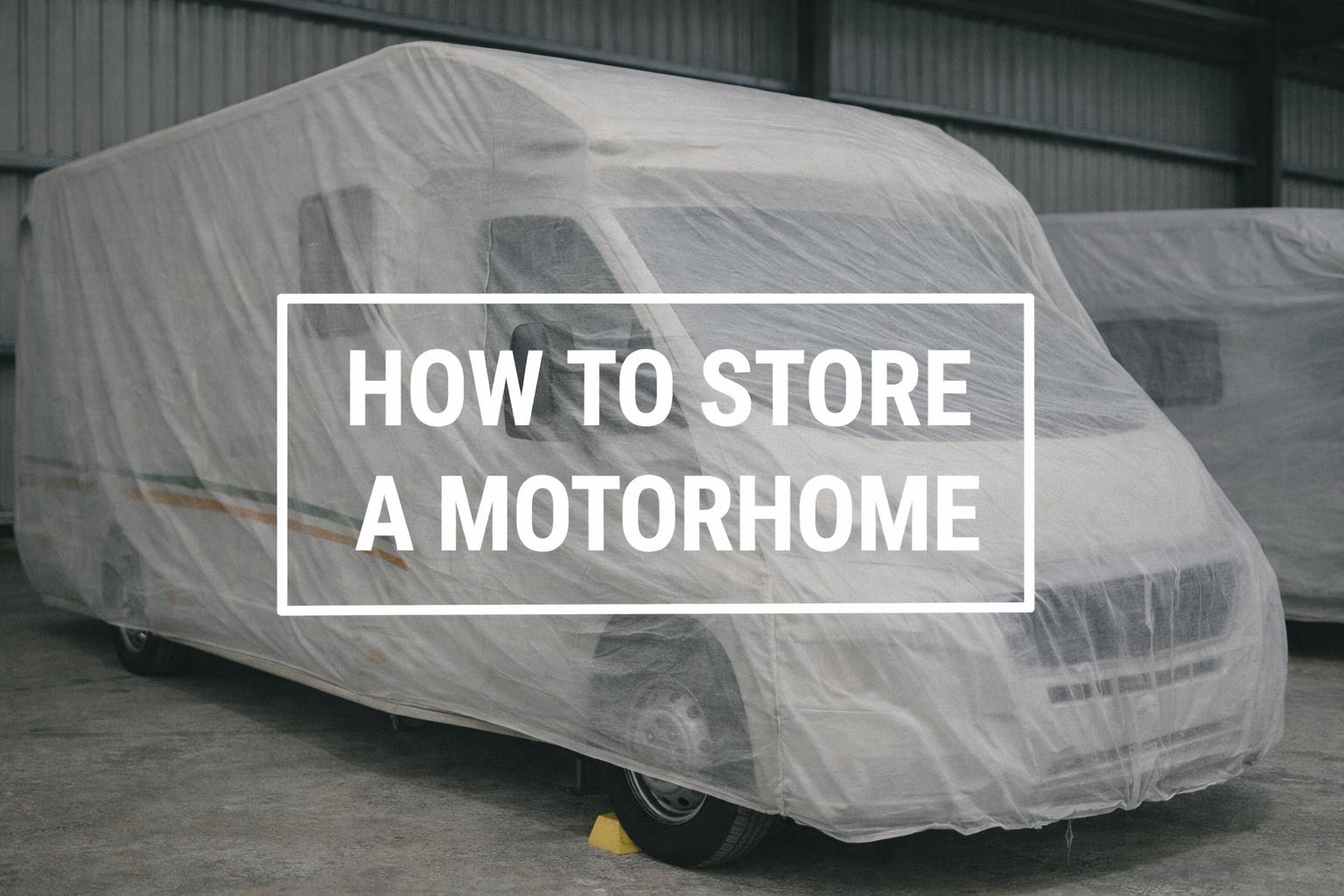

Proper motorhome storage all year long protects your vehicle, slows depreciation, and helps you retain a higher resale price when you list it. A motorhome is a self-propelled recreational vehicle; storing it correctly involves controlling moisture, power, security, and site conditions to keep all systems within safe limits.
Across this guide, you’ll see where to keep a motorhome (home vs storage facility), how storage choices affect insurance, what UK-specific options cost (GBP), and the steps to prepare for winter storage and safe recommissioning.
Key risks worth addressing early include frost damage to the water system, damp and mold from high humidity, battery sulphation during inactivity, rodent damage to wiring, UV and salt exposure, and theft.
Buyers notice vehicles that emerge from storage with a dry habitation area, healthy vehicle and leisure battery, clean service history, and documented checklists—these units sell faster and closer to the asking price.
Think of your storage set-up—breathable cover, airflow, trickle charge, and written checks—as asset protection, not convenience.
Key takeaways (main tips and best places):
- Store at home for oversight and cost control; choose a UK accredited storage facility for layered security.
- Prioritize hardstanding, drainage, and ventilation; avoid trees and high-flood areas.
- Prevent damp with airflow and moisture control; drain valves on the water system before freezes.
- Maintain battery care (starter and leisure) with trickle charge or periodic mains charging.
- Layer security measures: perimeter fencing, lighting, locks, immobilizer, and tracker.
How does storage influence motorhome value?
Proper storage directly influence your motorhome value.
Storage sets the condition baseline a buyer pays for. When you list, buyers are buying certainty. Proper storage reduces the unknowns that trigger price drops. It also strengthens your presentation.
A consistent storage routine keeps your motorhome looking like an asset, not a project. That matters because most buyers price in hassle. The more “ready to use” the van feels at viewing, the higher the offer tends to be.
Storage also affects valuation evidence. A clear, declared storage location, plus a facility invoice or driveway log, shows stability and lowers the fear of hidden problems.
It can also help your insurance history look clean, which makes future premiums easier to justify to a cautious buyer. Poor storage does the opposite. It creates doubt, and doubt becomes negotiation.
As a motorhome trader with over 30 years of experience, The Motorhome Trader can confirm that motorhomes had proper storage always hold higher resale value and always sell for more money than poor stored and maintained motorhomes. If you want top money, treat storage like part of your service history.
Record where it was kept, how often it was checked, and what you did to keep it sale-ready, for buyers with fewer surprises.
Where should you store your motorhome—at home or at a storage facility?
The clearest comparison is this: home storage maximizes convenience and cost control, while a storage facility maximizes security, space, and insurance optics.
At home, you gain daily oversight and little to no monthly fees, but visibility to thieves, HOA/covenant issues, and street obstruction risks can raise exposure.
A facility offers wide aisles, hardstanding, access control, CCTV, security lighting, and add-ons like wash bays, dump points, and electric hook-ups for a trickle charge; downsides are monthly costs and travel time.
For caravans, some sites offer seasonal pitches with electric hook-ups, though access may close outside those months. If you need regular winter check-ins or plan occasional rentals, pick a site with year-round access hours.
In the UK, insurers may discount accredited storage postcodes (e.g., CaSSOA sites), while mis-declared storage locations can invalidate claims. Decide based on cost, your driveway geometry, neighborhood crime data, weather exposure, and the resale optics you want when you sell.
Here is a direct comparison on the eight most important factors:
| Factor | Home (Driveway/Garage) | Storage Facility (Yard/Warehouse) |
| Cost | £0–£30 (utilities/security add-ons) | Outdoor £30–£120; Covered £60–£200; Indoor £120–£400; Climate-controlled £160–£500 |
| Convenience | Immediate access; daily oversight | Travel time; some sites restrict winter access hours |
| Security | Depends on your measures; visible to street | Layered: CCTV, access control, lighting, patrols, perimeter fencing |
| Space/HOA rules | Subject to deeds/bylaws/HOA; driveway shape and height | No HOA; wide aisles; hardstanding |
| Access/Power | Full control if you have sockets | Hook-ups sometimes available; hours apply |
| Insurance impacts | Visible street parking may raise risk | Accredited sites and declared postcodes can lower premiums |
| Weather exposure | As per home location; under trees = sap/branches | Options from outdoor to climate-controlled indoor |
| Resale optics | “Owner-maintained” can look good if documented | Climate-controlled/accredited storage impresses buyers |
What are the pros and cons of storing a motorhome at home?
Storing a motorhome at home is viable if you manage exposure risks and follow local rules (HOA/deeds/bylaws and on-street parking requirements).
Pros
- Save money with no (or minimal) monthly storage fees.
- Simplify access for last-minute trips, loading, cleaning, and routine checks.
- Maintain constant oversight of the habitation area, appliances, and battery/utility systems.
- Strengthen security by adding practical deterrents (motion lighting, basic CCTV, and visible locks).
- Reduce opportunistic theft by showing there are no valuables on display (e.g., blinds arranged to reveal nothing tempting).
Cons
- Increase theft visibility by keeping the vehicle in a predictable, publicly noticeable location.
Limit flexibility due to HOA/bylaw/deed restrictions (time limits, height/visibility rules, driveway rules). - Worsen weather and tree exposure (wind, sap, falling branches, UV, damp), which can accelerate wear.
- Create compliance risk if on-street parking obstructs traffic or violates local parking orientation rules (e.g., in the UK, park with the nearside to the pavement so rear lights are visible to approaching traffic).
- Invite nuisance attention if the motorhome looks “stored” rather than “in use” (complaints from neighbors or enforcement follow-ups).
Practical deterrence measures if storing at home: park nose-in, turn steering to full lock, block the vehicle with a locked driveway post or a second car, fit a visible wheel clamp plus steering/pedal lock, and add motion lighting with basic CCTV.
What types of storage facilities are available for motorhomes?
A storage facility is a dedicated place that provides space and security controls for a caravan or motorhome during off-season or long lay-ups.
Eight main types of motorhome storage include:
- Outdoor uncovered yards — Open compounds (often hardstanding) with wide aisles; security can range from basic fencing to CCTV, patrols, and ANPR at the gate.
- Covered canopy storage — Roofed bays with open sides that reduce UV and direct rainfall while staying lower-cost than full indoor.
- Indoor warehouse storage — Fully enclosed buildings that offer strong protection from weather, tree debris, and casual visibility.
- Climate-controlled indoor units — Temperature/humidity managed indoor storage; costs more but gives the best damp/UV control and strong resale optics.
- Mixed-use storage yards — Sites storing cars/boats/RVs together; convenient availability but security and access rules vary widely by operator.
- Self-storage with adjacent yards or containers — Urban-friendly and sometimes very convenient; may offer enclosed warehouses or containers, though pricing is often “on request.”
- Long-term car parks — Often council-operated season-ticket options near cities; can be cost-effective but typically lighter security than specialist compounds. Examples run roughly £33–£95/month in coastal counties and £108–£158/month in commuter cities, with some councils selling three-month blocks around £216–£420 (availability and vehicle-size rules vary).
- Specialist RV storage services — Purpose-built RV compounds that may add valeting, winterisation, repairs, waste dump points, wash bays, air/water, and electric hook-ups (handy for battery care).
Outdoor yards are usually the default “good value” option if you mainly need space, while indoor/climate-controlled suits long lay-ups where damp prevention and cosmetic protection matter most.
Specialist RV sites sit in the middle: you pay more than a basic yard, but the extra services can save hassle (and avoid nasty spring surprises).
What should you look for when choosing a storage facility?
Choose a facility that provides layered security, reliable access, sound ground conditions, clear contracts, adequate insurance, and positive reviews.
- Start with the surface: prefer hardstanding, good drainage, and avoid floodplains or areas under trees that shed branches or sap onto the roof panel.
- Confirm access hours in winter, whether staff live on-site, and any seasonal closures.
- Value add-ons that reduce “activation time” in spring—on-site water/air/electric, wash bays, dump points, and options to trickle charge.
- Ask for proof of the operator’s liability cover and understand your motorhome insurance policy requirements; keep photos of condition at drop-off to support any claim.
- Read the contract terms around access, termination, and rules for gas cylinders, Thetford cassette toilet management, and fire safety.
What security standards should a storage facility meet?
A suitable site has monitored CCTV, controlled entry, strong lighting, robust perimeter, and a documented incident response.
Look for a single secure gate with card/fob or keypad access, ANPR, and high-integrity fencing, earth mounds, or ditches. Lighting should remove shadow pockets; CCTV should record and ideally be monitored.
Regular patrols or resident staff increase security. Check that gas cylinder rules are enforced and that liability cover is up to date. Fire safety measures and secure storage for flammables should be in place and visible.
How important are location and accessibility?
Location and access are critical because travel time, hours, approach roads, and local risk directly affect usability and safety.
Prefer elevated, well-lit areas with surveillance, and verify flood maps for the postcode. A
ssess approach roads for width, turning space for large rigs, and winter gritting on hills.
Confirm evening/weekend access; many indoor sites limit out-of-season entry. Review neighborhood crime data and choose a route that avoids tight streets and low bridges.
How should ventilation and moisture be controlled in storage buildings?
Dry, well-ventilated buildings reduce condensation, mold, and water ingress. If heated, around 20°C is better than 5–10°C ranges that promote condensation. Encourage cross-flow airflow and allow dehumidifiers or moisture absorbers inside the van with safe drains. Keep fridge vents unobstructed and ensure entrances are weather-sealed and insulated so doors don’t become condensation hotspots.
Where are you not allowed to store a motorhome?
You can’t store a motorhome where it violates bylaws, lease terms, fire lanes, protected zones, height limits, or causes obstruction.
Even where on-street parking is legal, it must not block traffic or views, and in the UK the nearside should face the pavement so rear lights face approaching traffic. Some deeds or covenants cap driveway duration or visibility; landlords may prohibit large vehicles.
Many enclosed storage buildings require gas cylinders removed and stored upright in ventilated outdoor compounds.
What is a CaSSOA site and does accreditation matter?
CaSSOA is the UK Caravan Storage Site Owners’ Association that audits and accredits storage facilities to Bronze, Silver, Gold, or Platinum levels.
The scoring spans CCTV/surveillance, perimeter integrity, alarms, fire safety, and controlled entry. Insurers often ask for the site’s accreditation details and may offer lower premiums for accredited storage.
Accreditation strengthens baseline security and insurance optics, but it’s not a substitute for layered personal security—use a steering lock, wheel clamps, deadlocks, and a tracker, and read the site’s access and insurance terms carefully.
Can you store a motorhome on your driveway?
Yes—if local bylaws, deeds/HOA rules, and neighbors’ sightlines allow it, and you apply strong security and damp control.
- Position nose-in, put wheels on full lock, install a removable bollard, and fit visible wheel clamps; motion lights and a basic camera add deterrence.
- Keep blinds and doors positioned so valuables aren’t visible; avoid trees that drop debris.
- Check covenants for duration or visibility limits, and ensure the vehicle doesn’t obstruct junction sightlines.
How do you insure a motorhome during storage?
You need appropriate insurance during storage, and you must tell your insurer exactly where and how the vehicle is stored.
The five main steps are:
- Start by declaring the storage address/postcode, access conditions, and security (locks, alarm, tracker, CaSSOA level if applicable).
- Choose coverage to match your status: comprehensive all year, or laid-up cover if the vehicle is off-road (fire, theft, storm, and vandalism). If you submit a SORN, road risks aren’t covered, so confirm your policy switches to garage/laid-up terms and read exclusions.
- Keep tracker subscriptions active; many alarms/trackers draw from the starter battery, so plan charging or a solar panel maintainer.
- Some UK insurers require winter drain-down between Nov 1 and Mar 15 and may mandate Thatcham-rated immobilizers or trackers for higher-value units.
- Document everything—photos before storage, receipts for security products, and the facility contract—so a claim has clear evidence. Accreditation and lower-risk postcodes can reduce premiums; mis-declaration can void them.
Do you need to tell your insurer where the motorhome is stored?
Yes—declaring the storage location and security is mandatory to keep your cover valid and priced correctly.
Provide the full address/postcode and specify whether it’s a home driveway/garage, an accredited storage facility, or a council long-stay car park with a season ticket.
List access control, CCTV, lighting, staff presence, your on-vehicle security, and any connection to power for trickle charge. Mis-declaration can invalidate HJY5weather or theft claims. Conversely, storing at a CaSSOA-accredited site can help reduce premiums.
Do you need insurance when the motorhome is off the road or in storage?
Yes—if the vehicle is off the road, laid-up cover protects against fire, theft, storm, and vandalism while it’s static.
Expect exclusions on road risks and sometimes contents; some insurers offer year-round cover with off-season options.
Keep documentation such as photos before storage, contracts, and receipts as claim evidence. Confirm whether your policy requires drain-down, specifies alarm/tracker use, or sets conditions for gas cylinders in the gas locker.
How do storage choices affect premiums and security requirements?
Storage decisions influence risk rating, required devices, and price. High-risk postcodes and on-street parking generally raise premiums; secure compounds and CaSSOA sites often reduce them.
Insurers may require Thatcham-rated alarms/trackers above certain vehicle values; keep backup battery health and subscriptions current. Evidence—photos, logs, and invoices—supports discounts and speeds claims. Report storage changes quickly to keep your policy updated.
How much does motorhome storage cost?
UK pricing varies by region and specification, but typical monthly ranges are:
- outdoor £30–£120 per month
- covered £60–£200 per month
- indoor £120–£400 per month
- climate-controlled £160–£500 per month
Annual contracts often total £300–£1,000+ depending on county, access, and services.
Council long-stay car parks can be £33–£95/month in coastal counties and £108–£158/month in commuter cities; a few councils price three-month blocks around £216–£420 (£72–£140/month).
Within a single county, hardstanding vs grass, ANPR/patrols, dump/wash/electric services, and motorway proximity shift rates upward. Some operators price per season or per day (e.g., £2.50–£3/day), with discounts for longer terms and surcharges for short stays.
Ten main factors affect motorhome storage cost:
- Location risk: Postcode crime/flood exposure changes premiums and site pricing.
- Facility type: Outdoor, covered, indoor, or climate-controlled tiers.
- Unit size/length: Longer or taller vans occupy more storage area.
- Access hours: 24/7 or limited winter access influences price.
- Security level: Perimeter fencing, CCTV, patrols, monitored access.
- Climate control: Temperature and humidity regulation.
- Contract length: Annual discounts vs rolling monthly rates.
- Insurance surcharges: Requirements tied to storage location.
- Add-ons: Power hook-up for trickle charge, wash bays, dump points.
- Seasonal demand: Autumn influx and spring turnover adjust rates.
How do you prevent rodents and pests from entering a stored motorhome?
Preventing rodents requires removing attractants, sealing openings, using deterrents/traps, and inspecting on a schedule. This how-to includes 7 steps.
- Remove all attractants: Clear every food item, pet food, scented soaps/candles, and garbage. Empty the fridge and prop the fridge door open; vacuum cupboards and mop floors to erase food odors.
- Seal entry points: Mice can pass through 5–6 mm gaps. Prioritize cable/pipe penetrations, low vents, and boiler flues; use steel wool/mesh, plates, and rubber grommets while preserving safe airflow.
- Deploy deterrents: Peppermint oil, ultrasonic devices, and repellents help deter pests; place near tires and entry points.
- Set traps safely: Use snap or enclosed traps where legal and pet-safe; check frequently and record results. Avoid poison where wildlife or pets could access bait.
- Protect the engine bay: Inspect air filter housing, belts/hoses, fuel and brake lines, and seatbelt lower mounts; look for nesting signs.
- Choose better ground: Park on hard, stony ground; pests avoid sharp surfaces.
- Schedule inspections: Check monthly for droppings, chewed insulation, and damp; move the van slightly to disrupt nesting.
Check our guide on motorhome pest and rodent control for more tips and step-by-step lists.
What should you remove from the motorhome to deter rodents?
Remove all edible and scented items to avoid attracting rodents. That includes foodstuffs, pet food, sweets, soap, candles, and open liquids.
Empty and prop open the fridge/freezer, clear crumbs from cupboards, vacuum upholstery, and lift loose carpets to mop floors.
Take out clothing, bedding, cushions, and towels (or stack them centrally for airflow).
Remove paper/cardboard and leaflets that trap moisture. Dispose of all waste so no smell remains.
What deterrents and sealing methods help keep rodents out?
Seal small openings and combine physical barriers with targeted deterrents. Inspect vents and cable routes; fit mesh and grommets while maintaining necessary air flow for appliances.
Use traps in tamper-resistant housings where safe and legal, and place repellents near tires and door openings. Avoid bait where pets or wildlife could be harmed.
Check monthly; move the vehicle a short distance to change contact points and disturb nests.
Look inside air filter boxes, boiler flues, and under sink cabinets for build up or nesting material.
How do you prepare a motorhome for winter storage?
Preparing a motorhome for winter involves cleaning, draining, securing, powering safely, and documenting condition. Here are the 12 main steps:
- Service and inspections. Book engine service, habitation/damp checks, and roof seam review to catch issues early.
- Exterior wash and protection. Wash, rinse roof/gutters, clean glass/panels, and apply wax or sealant.
- Water system drain-down. Open low-point drains, tanks, and taps; manage mixer taps; follow your chosen method (blow-out or RV antifreeze).
- Gas system shutdown. Turn off at cylinder and regulator; run residual gas off via hob with windows open; label cylinders.
- Battery care. Disconnect or maintain with an intelligent charger; plan power for alarm/tracker (starter battery) and the leisure battery.
- Tires and brakes. Inflate to spec (or slightly higher), chock wheels, leave handbrake off, and move the vehicle monthly.
- Fuel stabilizer (if applicable). Dose and run to circulate through the system.
- Lubricate seals/locks. Treat door, locker, and window seals; lubricate hinges and locks.
- Pest-proofing. Remove attractants; seal cable/pipe routes; set traps as needed.
- Cover and ventilation. Use a breathable cover; ensure air circulation and avoid sharp edges that abrade.
- Interior prep. Clean appliances, prop the fridge door, crack vents/windows as safe, place moisture absorbers.
- Documentation. Photograph condition, record voltages and mileage, and file receipts and insurance confirmations.
How do you drain and protect the water system to prevent frost damage?
Draining and protecting the water system means emptying all tanks, purging lines, and safeguarding valves and the water heater. Follow this simple 6 steps:
- Position for drainage. Park on a slight tilt so low-point drains are at the lowest side. Open fresh, gray, and waste drains.
- Open faucets systematically. Run taps and shower; position mixers midway to clear both hot and cold lines.
- Empty accessories. Remove the shower head, shake out water, and leave hose in the tray; don’t forget exterior showers and onboard tanks.
- Water heater. Follow the manual to drain a balanced-pressure water heater; pull drain plugs and relief valves as specified.
- Purge the lines. Use a blow-out device with regulated compressed air, or circulate potable RV antifreeze per instructions—never mix methods.
- Compliance and notes. Some UK policies require drain-down between Nov 1–Mar 15; document the date and keep photos.
How do you protect a motorhome from damp and moisture during storage?
The two most important steps are control humidity and maintain airflow to prevent condensation, mold, and water ingress.
- Aim for a dry interior; if indoors and heated, ~20°C is better than borderline low heat that encourages condensation.
- Leave cupboards/lockers ajar, place moisture absorbers in closed spaces, and consider a timed dehumidifier with safe drains.
- Inspect roof seams, windows, and seals before storage; reseal as needed.
- Vent the fridge with winter covers as appropriate, and monitor relative humidity with a small electronic meter.
As a professional motorhome trader with over 30 years of experience, The Motorhome Trader has a complete guide on how to manage damp in motorhomes and prevent mold and mildew to protect your motorhome value over the years.
How do you care for and maintain batteries during storage?
Maintain batteries within safe state-of-charge and temperature ranges using smart charging and periodic checks.
Lead-acid batteries self-discharge; a maintainer prevents sulphation. If no mains power is available at the storage site, remove batteries for home charging or use a solar maintainer.
Keep alarms/trackers powered—often from the starter battery—and measure voltage every few weeks; around 12.4 V after two weeks suggests attention is due.
Lithium systems follow manufacturer SOC targets and low-temperature charging rules. If you must run the engine, drive for about 40 minutes; modern alternators are inefficient at idle.
How should you handle and store gas cylinders and shutoff valves before storage?
Shut off, depressurize safely, and follow facility rules for cylinder storage. Turn off at the cylinder and regulator, then run residual gas from the hob/grill with windows open.
Many facilities require cylinders to be removed and stored upright in ventilated outdoor compounds; cap and label them.
Before recommissioning, leak-check lines with an approved solution and inspect the gas locker seals.
How should you clean and empty interior appliances before storage?
Leave appliances clean, dry, and vented to prevent odors and corrosion. Defrost and prop the fridge/freezer doors open; fit winter fridge vents if used.
Clean the cooker, wipe drains and traps, sanitize the toilet, and lubricate Thetford cassette seals with silicone-safe products.
Slightly open interior doors for air circulation without inviting pests.
How should you deal with soft furnishings and textiles before storage?
Minimise moisture build-up and deter pests while maintaining item shape. Remove cushions, bedding, and clothing if possible, or stack centrally for airflow.
Use breathable bags rather than plastic; place desiccants in wardrobes and under seats. At each inspection, rotate items and check for damp or mould.
Should you wash and wax a motorhome before storage?
Yes—pre-storage washing and protection reduce staining and spring workload. Remove bird lime, tree sap, and road dirt so acids don’t etch paint or roof panels. Apply wax or over-winter sealant after drying. Clean solar panels to support any trickle charge. Rinse gutters and clear debris that could trap water or lead to leaks.
Should you cover your motorhome during storage?
A breathable, well-fitted cover helps—non-breathable tarps do harm. Multi-ply breathable covers reduce dirt and UV damage while allowing air flow; avoid plastic tarps that trap moisture and abrade paint.
Fit only after washing, strap snugly to prevent flapping, and consider a roof-only topper if full covers are impractical or winds are high.
If the cover shades the solar panel, use a portable maintainer or one with a clear window
How should you store and maintain tires during storage?
Protect tires from flat-spotting, UV, and chemical damage. Inflate to the recommended pressure (or a touch higher), use levelers/jacks per the manual to offload weight, and move the vehicle monthly to change the contact patch.
Use UV covers if outdoors; avoid parking on grass. Chock the wheels and leave the handbrake off to prevent seizing.
How should you keep alarms and electrical systems working during storage?
Maintain alarm/tracker power and verify alerts without draining batteries. Use a maintainer, periodic mains charge, or solar to support battery power.
Test geofences, alerts, and silent sirens; renew subscriptions as needed.. Record voltages so you can spot trends.
What supplies should you leave in the motorhome during storage?
Leave only non-perishable essentials that support safety and maintenance. A compact tool kit, spare fuses, jack, wheel chocks, locking-nut keys, moisture absorbers, printed maintenance checklist, and logbook copies (not sensitive originals) are useful.
Take out valuables and perishable items.
How often should you perform maintenance checks during winter storage?
Inspect every 2–4 weeks and after extreme weather. Inspect tire pressures, battery voltages, signs of condensation or water ingress, nests under the bonnet and in boiler flues, and that the exhaust is unobstructed.
If permitted, drive 30–40 minutes to warm fluids and charge the system. Move the van slightly, cycle the brakes, refresh moisture absorbers, and log findings with dates and meter readings.
How should you store a motorhome outdoors in winter?
Outdoor winter storage works if you manage ground conditions, airflow, power maintenance, and security. Park on hardstanding with a slight slope for drainage and avoid trees that shed branches or sap.
Orient to reduce wind loading and direct sun on seals; remove snow loads promptly. Use a breathable cover, tensioned or supported by a frame so it sheds water and maintains air flow without rubbing the paint.
Manage damp with moisture absorbers and periodic ventilation, safeguard tires, chock wheels, and leave the handbrake off per the manual. Turn off gas at the cylinder and remove cylinders if the storage site requires.
Schedule periodic checks after storms and sub-zero snaps; confirm alarm/tracker status and battery voltages. In coastal regions, rinse salt from the underbody where possible to minimise corrosion.
How should you store a motorhome indoors in winter?
Indoor storage reduces weather risk, but you still need airflow, battery care, and safety controls. A dry, ventilated building is sufficient; if heated, around 20°C is preferable to 5–10°C, which encourages condensation.
Maintain air circulation, consider dehumidifiers with safe drains, support battery maintenance, and use drip trays under fluids.
Keep pest prevention active even indoors. Confirm access hours in winter and site fire safety rules, including how gas cylinders are handled and which extinguisher types are available.
Here is our seven tips checklist:
- Exterior: Wash, apply wax or sealant, clean roof and gutters, wipe solar panels, fit a breathable cover, and photograph condition before storage.
- Interior: Deep clean, fridge door propped, cupboards ajar, moisture absorbers placed, soft furnishings stacked centrally.
- Water/Gas/Electric: Drain valves open, water heater drained, mixer taps mid-position, gas off and cylinders managed, chargers/maintainers set, voltages recorded.
- Tires/Chassis: Inflate, chock, handbrake off, move monthly; inspect brakes and suspension.
- Security: Steering/pedal locks, wheel clamps, immobilizer, tracker set with geofences; security lighting where applicable.
- Documents: Log dates, meter readings, photos, receipts, facility contract, and confirm insurance coverage of storage location.
- Scheduled check-ins: Calendar reminders every 2–4 weeks; after storms, re-inspect cover tension and seals.
Where can you find motorhome storage near you?
To find motorhome storage near you use accreditation lists, council resources, and map queries, then assess each operator on security and ground conditions.
You can search queries like:
- “motorhome storage + [town/county]”
- “accredited caravan storage”
- “long-stay car park season tickets + [council]”
In the UK, check CaSSOA-accredited site directories and read reviews that mention drainage, flood risk, perimeter fencing, and access hours.
Compare security layers (CCTV, monitored entry), staff presence, lighting quality, and on-site services such as wash bays, dump points, and electric hook-ups.
Verify insurance compatibility—some insurance policies prefer accredited postcodes and defined security measures.
Always arrange a site tour to confirm space, turning room, and contract terms before you sign.
What is off-season motorhome storage?
Off-season motorhome storage is the autumn–spring lay-up period in which the vehicle remains static while systems, structures, and finishes are protected from environmental stressors and inactivity risks.
The objective is to prevent freeze damage in the water system and water heater, limit UV and salt exposure, control humidity to deter condensation and mold, and avoid battery sulphation and tire flat-spotting through managed charging and periodic movement.
Security controls are scaled to local theft risk, often combining immobilizers, visible clamps/locks, monitored CCTV, and trackers, with documented checks to satisfy insurance and preserve resale value.
Poor storage triggers damp smells, roof leaks, rodent chew in wiring, corrosion from salt, flat-spotted tires, and dead batteries—each becomes a buyer’s bargaining point.
How does climate and location impact motorhome storage?
Climate and environmental conditions dictates the choice of motorhome storage in six different ways:
- cold demands freeze protection
- coastal needs anti-corrosion: coastal UK locations call for covered/indoor storage and regular rinsing
- hot/humid needs UV and mould control
- arid climate needs seal care
- high altitude adds UV and thermal swings
- rural barns may raise rodent exposure—intensify pest control.
- urban postcodes may raise theft risk—layer security
- indoors, mold dry ventilation; if heated, ~20°C limits condensation better than low, damp warmth.
The Motorhome Trader strongly suggests you to always match your storage measures to local weather patterns, flood maps, and neighborhood crime data.
How do you secure a motorhome in storage?
Securing a stored motorhome involves layering physical locks, immobilization, tracking, and documentation.
Here is our six steps checklist:
- Positioning and obstacles. Park nose-in with wheels on full lock; add a driveway post or second vehicle as a physical blocker.
- Visible deterrents. Fit two quality wheel clamps plus a steering or pedal lock; use security lighting and CCTV where possible.
- Immobilizer and deadlocks. Add certified immobilizers and door deadlocks; consider OBD port blockers.
- Tracker strategy. Install a Thatcham-rated tracker, set geofences, choose a sensible ping cadence, and maintain backup battery power.
- Marking and inventory. Etch the VIN in windows, record serial numbers of appliances and valuables, and apply deterrent stickers.
- Documentation. Photograph set-up, keep invoices, and record alarm/tracker tests; this supports insurance and discourages thieves.
Which anti-theft devices and products should you use for stored motorhomes?
Use independently tested devices and layer them to slow attacks and increase noise and time.
Choose wheel clamps and hitch locks rated to resist power tools for 15–20 minutes, add steering and pedal locks, install deadlocks on habitation and garage doors, and consider an OBD blocker.
Look for Thatcham categories where applicable. Etch the VIN, record serials, and place visible deterrent decals.
How do you set and maintain alarms and trackers during storage?
Keep systems powered, configured, and tested without draining batteries.
Maintain battery power with a maintainer or scheduled mains charge; verify geofences, ping cadence, and remote notifications.
Run silent siren tests, confirm the call tree, and keep subscriptions current. Monitor battery state remotely when the control system supports it.
What are security standards for storage sites and pitches?
Expect a secure perimeter, bright lighting, controlled access, and documented incident response.
Prefer single-entry compounds with card/fob/keypad control and ANPR, visible cameras, and well-placed lighting.
Check patrol frequency, staff presence, and fire safety procedures, including gas cylinder management rules.
How often should you check on a motorhome during storage?
You should check on a motorhome storage site every 2–4 weeks, and immediately after severe weather or sub-zero periods.
During each visit:
- measure battery voltages
- check tire pressures
- inspect roof seams and cover tension
- look for water ingress and condensation
- scan for rodent signs around boiler flues and the engine bay.
- shift the vehicle slightly to change the tire contact patch
- cycle the brakes
- refresh moisture absorbers
- after storms, confirm no snow or ice build-up and that drainage paths are clear
- log readings and photos so trends are obvious.
How do you take a motorhome out of storage safely?
Reactivating safely requires structured inspections, power and fluid checks, system tests, and a short shakedown drive.
Here are the ten main steps.
- Exterior walk-around. Look for damage, leaks, cover abrasion points, and rodent signs.
- Security systems. Re-enable alarms/trackers; test notifications.
- Battery reconnection/charge. Reconnect, top up with a smart charger, and confirm voltages.
- Tire pressures. Inflate to spec, inspect sidewalls and valve stems.
- Fluids. Check engine oil, coolant, brake fluid, and screenwash; inspect for leaks.
- Gas safety. Refit cylinders if removed, open valves, and soap-test joints.
- Water system. Close drains, refill the fresh tank, flush lines, and sanitize; confirm water heater operation.
- Appliances: test heating, fridge, and electrical systems.
- Brake and steering. Check operation at low speed; listen for binding.
- Shakedown drive. Drive locally to verify performance and recheck for leaks on return; compare to pre-storage photos/logs.
What is the step-by-step de-winterization checklist?
Follow a defined sequence so systems pressurize and vent safely:
- Close drain valves
- insert bungs/filters, and refill the fresh water tank
- Sanitize lines to spec
- reinstall the shower head
- bleed air from faucets
- reconnect batteries and verify charging
- open gas at the cylinder/regulator
- soap-test joints
- relight appliances according to the manual
- confirm CO and LPG detectors power up
- verify the heating system run-up and that the fridge transitions through modes without fault codes
How do you test gas, water, electrical, and safety systems after storage?
Always test one system at a time and validate detectors and RCD/GFCI protection.
Replace detector batteries, check expiry dates, and use a calibrated gas detector if available.
Confirm RCD/GFCI trip/reset behavior. Pressurize water slowly, watch for leaks, and run the water heater under supervision.
Check charger output, battery current, and that the control system reports stable voltages and temperatures.
How should you document storage and maintenance to protect resale value?
To document motorhome storage and maintenance always keep a storage dossier with dates, readings, photos, receipts, contracts, and insurer confirmations.
- Record battery voltages, tire pressures, drain-down dates, and service actions.
- Photograph roof seams, under-bonnet hoses, boiler flues, and interior corners each season.
- File storage facility contracts, CaSSOA details, and insurer emails that confirm the declared storage location and security measures.
- When you sell, present a concise pack that includes winterization and de-winterization checklists, invoices for security products, and a timeline of maintenance—this demonstrates care and lowers buyer uncertainty.
For more insider tips and details, check our guide on how to value a motorhome.
When should you take your motorhome out of storage and what post-storage checks are essential?
Schedule early spring checks to allow time for any remedial work before the season. During the first visit, check fluids, brakes, detectors, electrical systems, and tires. A brief local drive helps surface any issues before long trips.
Should you take a short shakedown trip before listing for sale?
Yes—a weekend shakedown validates systems under real use and produces credible proof for buyers.
Choose a local route with varied speeds and a safe return. Keep receipts for any fixes and add a clean post-trip checklist to your sale dossier.
What are the most common motorhome storage mistakes to avoid?
Here are the seven common mistakes that cause damage, claims disputes, and lost resale value:
- Don’t skip drain-down, seal a van without ventilation, or leave food or scented items inside
- Don’t neglect batteries or tires, ignore insurance declarations, or use non-breathable tarps.
- After storms, don’t forget to recheck the cover and seams.
- Leaving the handbrake on (risk of seizing)
- Parking under trees
- Blocking solar without an alternate charger
- Failing to remove gas cylinders where the site rules require it.
Can towing restrictions, licensing, or inspections affect where or how you store a motorhome?
Yes—legal limits on access, height/width, permits, and periodic inspections can dictate storage choices and movements.
Driveway geometry and gate width determine safe egress; low bridges or permit zones affect route planning to a storage site.
If you uprate vehicle weight class, confirm license entitlements and allowable towing weights for trailers you plan to move to or from storage. Keep inspection schedules current so the vehicle can be driven legally when needed.
How do you ventilate a stored motorhome without inviting damp or pests?
Balance controlled airflow with screened openings and moisture management.
Crack roof vents or windows that have insect screens; leave internal doors and cupboards ajar to promote cross-ventilation.
Place moisture absorbers or a dehumidifier with safe drainage in humid areas.
Seal low-level pest ingress points with mesh/grommets without blocking appliance airflow. Choose a breathable cover tensioned to prevent condensation pockets.
Should you rent out your motorhome during the off-season or storage period?
You can, but only if insurance, security, and maintenance logistics are addressed.
Hire-use policies differ from private storage insurance; end any off-road notifications before rental. Platforms may require specific alarm/immobilizer and tracker standards. Expect cleaning and turnover work between hires, battery charging, fluid checks, and documented inspections.
If stored at a facility, ensure access hours support pick-ups/returns and that contracts allow hire-use.
Conclusion
Storing a motorhome is a value-retention strategy: choose the right storage site, control moisture and airflow, maintain battery power and layered security, and document everything.
A disciplined winterization/de-winterization routine, periodic check-ins matched to weather and local risk, and clear insurance declarations reduce downtime and protect resale value when you decide to sell your motorhome.
Treat storage as planned hibernation—not a parking space—and your vehicle will emerge in better condition, ready for the next season or a confident sale.