
Winterising your motorhome every year is essential because it protects long-term motorhome value, keeps you safe, and saves you from costly repairs.
A proper routine touches every system: the water tank, drain valve, drain tap, shower head, toilet system, and flush water supply tank; the leisure battery and electrical equipment; the fuel tank, coolant, and gas heaters like a Truma Ultrastore boiler or older Carver boiler; and the structure, seals, soft furnishing, and tires.
Insurers and warranties often exclude frost or ice damage to plumbing, which means winterisation is your responsibility, and it’s important you get it right.
Plan an afternoon for your first attempt, and each year you’ll notice it becomes quicker, of course only if you are consistent. Regular care stops mould growth, water ingress, and hidden odors that can hurt resale value.
Remember, batteries can self-discharge in as little as 2–3 weeks, leading to sulfation if ignored.
A careful wash, wax, and breathable cover prevent algae and reduce spring clean-up, while tarpaulins put your motorhome at risk of abrasion and condensation. In this article, we’ll focus on how to get it right and keep your motorhome in the best shape all year round.
What Is Motorhome Winterisation?
Motorhome winterisation is a preventative maintenance protocol designed to reduce risks caused by freezing, moisture, corrosion, and prolonged inactivity across all major onboard systems.
It applies to the plumbing and water system, including the water tank, drain valve, drain tap, shower head, flush water supply tank, carbon filter, and toilet system with its toilet cassette. It also protects HVAC units or older Carver boilers, DC electrical equipment, the leisure battery, internal combustion engine and fluids, LPG supply, structural seals, tires, and security fittings.
For storage, the process emphasizes full drain-down, air purge, and the circulation of propylene-glycol RV antifreeze through potable circuits.
For winter use, the focus shifts to heat retention, insulation, and active freeze protection such as tank heaters and pipe wraps. Because residual water can remain in tankless or hydronic coils, antifreeze circulation is critical where blowing out alone is insufficient.
Why Is Winterizing Your Motorhome Important?
Winterising your motorhome is important because unprotected systems fail quickly when exposed to freezing temperatures.
Even half-inch water lines can split after only a few hours below 32 °F, leaving pumps and valves damaged when you attempt to recharge the water system in spring. Residual water left in a flush button circuit or wash water line can lead to cracks you won’t see until pressure builds.
Without maintenance charging, a leisure battery can discharge in just two to three weeks, causing sulfation and shortening its life.
Tires suffer flat-spotting under static loads; adding 3–5 PSI or rotating them from time to time prevents long-term damage. Moist winter interiors with soft furnishing encourage mould growth unless you ventilate with a steady flow of air.
Propping the fridge door, emptying tanks, and fitting a breathable cover all reduce water ingress and odor. Insurers often exclude frost damage, so prevention is your duty.
Visible deterrents like a steering wheel lock rated Sold Secure also protect your vehicle during storage, whether at home or in a facility such as Green Hill Farm Caravan and Camping Park.
Now that you know how important it is to keep your motorhome winterised, you should also be familiar on the right time to do it because this matters a lot as well.
When Should You Winterise a Motorhome?
You should winterise a motorhome before the first forecasted hard freeze or when overnight temperatures are expected to remain at or below 32 °F for consecutive nights.
This is the clearest trigger, because even a small amount of residual water in a drain tap, drain valve, or flush water supply tank can freeze, expand, and rupture fittings.
If you store the vehicle indoors above freezing, you can delay some plumbing tasks, but the fuel tank, tyres, and electrical equipment still need attention. For those taking short winter trips, you can keep the interior around 50 °F with mains power heaters and insulated tanks, or re-winterise after two to three idle days in freezing conditions.
It’s best to carry out full winterisation in early or mid-autumn, when the work is cleaner and safer.
Acting early ensures your water system, leisure battery, and soft furnishing remain protected through prolonged inactivity. Winterising your home without knowing the right temperature to operate at is just a waste of time, so let’s discuss that in the next section.
What Temperatures Trigger Winterisation to Prevent Freeze Damage?
You should treat 32 °F as the point at which winterisation becomes non-negotiable, because pipes in unheated bays can freeze even faster once ambient dips into the 30 to 25 °F range for several hours. Unprotected underslung tanks, shower head lines, and toilet cassette connections are especially vulnerable at −1 to −4 °C.
Wind accelerates cooling, drawing heat away from the water tank and floor-level components through conduction, while humidity contributes to water ingress that later freezes.
What Does Motorhome Winterisation Involve Overall?
Motorhome winterisation touches every system in your vehicle, from the plumbing and water system to the security setup at the storage site.
- You’ll drain the water tank, open each drain valve and drain tap, then blow out lines at 20–30 PSI to clear residual water before circulating propylene-glycol antifreeze.
- The water heater must be bypassed, whether you have a Truma Ultrastore boiler or a Carver boiler, so you don’t waste 30 liters of fluid.
- Appliances such as the outside shower head, flush water supply tank, and toilet cassette need separate treatment, and carbon filter housings should be emptied.
- The leisure battery and other electrical equipment require float charging with mains power or removal for warm storage.
- Engine and fluids are checked, including coolant and washer fluid, while the fuel tank should be filled to reduce condensation.
- Propane cylinders are isolated and stored upright.
- Finally, you wash, wax, fit a breathable cover, inflate winter tyres, and secure the motorhome with a steering wheel lock and Sold Secure devices.
What Are the Different Stages of Motorhome Winterisation?
The process unfolds in a structured sequence, beginning with preparation and ending with routine storage checks. Each stage matters because missing one creates weak points that can lead to water ingress, mould growth, or premature wear.
The main stages of motorhome winterisation include:
- Site and safety prep: Position on firm ground, chock wheels, and confirm access to each drain tap.
- Drain and clean tanks: Empty the water tank, open all valves, and rinse to clear wash water.
- Water-system protection: Blow out lines, bypass the heater, and add PG antifreeze through fixtures.
- Appliances and traps: Treat the shower head, flush button circuits, and toilet system lines.
- Cassette and waste tanks: Rinse the toilet cassette and lubricate seals lightly with olive oil.
- Electrical and batteries: Charge the leisure battery or maintain it with mains power.
- Engine and fluids: Fill the fuel tank, check coolant, and top winter washer fluid.
- Gas isolation: Shut bottles, store cylinders upright, and cap regulators.
- Interior control: Stand soft furnishing cushions upright, ventilate with steady flow of air.
- Exterior and tires: Wash, wax, fit a breathable cover, inflate tyres, rotate time to time.
- Storage site and security: Choose a safe location such as Green Hill Farm Caravan and Camping Park, fit a steering wheel lock, and add Sold Secure devices.
- Monthly checks: Visit the motorhome to inspect for mould growth, battery charge, and overall condition.
How Do You Drain and Protect the Motorhome’s Water System for Winter Storage?
Winter storage prep is all about removing water, clearing hidden pockets, and protecting vulnerable components so nothing freezes, cracks, or grows mould. Follow this consistent order—drain, blow-out, bypass, antifreeze, filter removal, and waste treatment—in 7 steps:
- Drain the fresh water tank so most wash water leaves the system before you touch the lines.
- Purge the water system with compressed air to clear residual water trapped in low points and fixture runs.
- Bypass the water heater so you don’t fill the boiler with propylene glycol or leave water trapped inside.
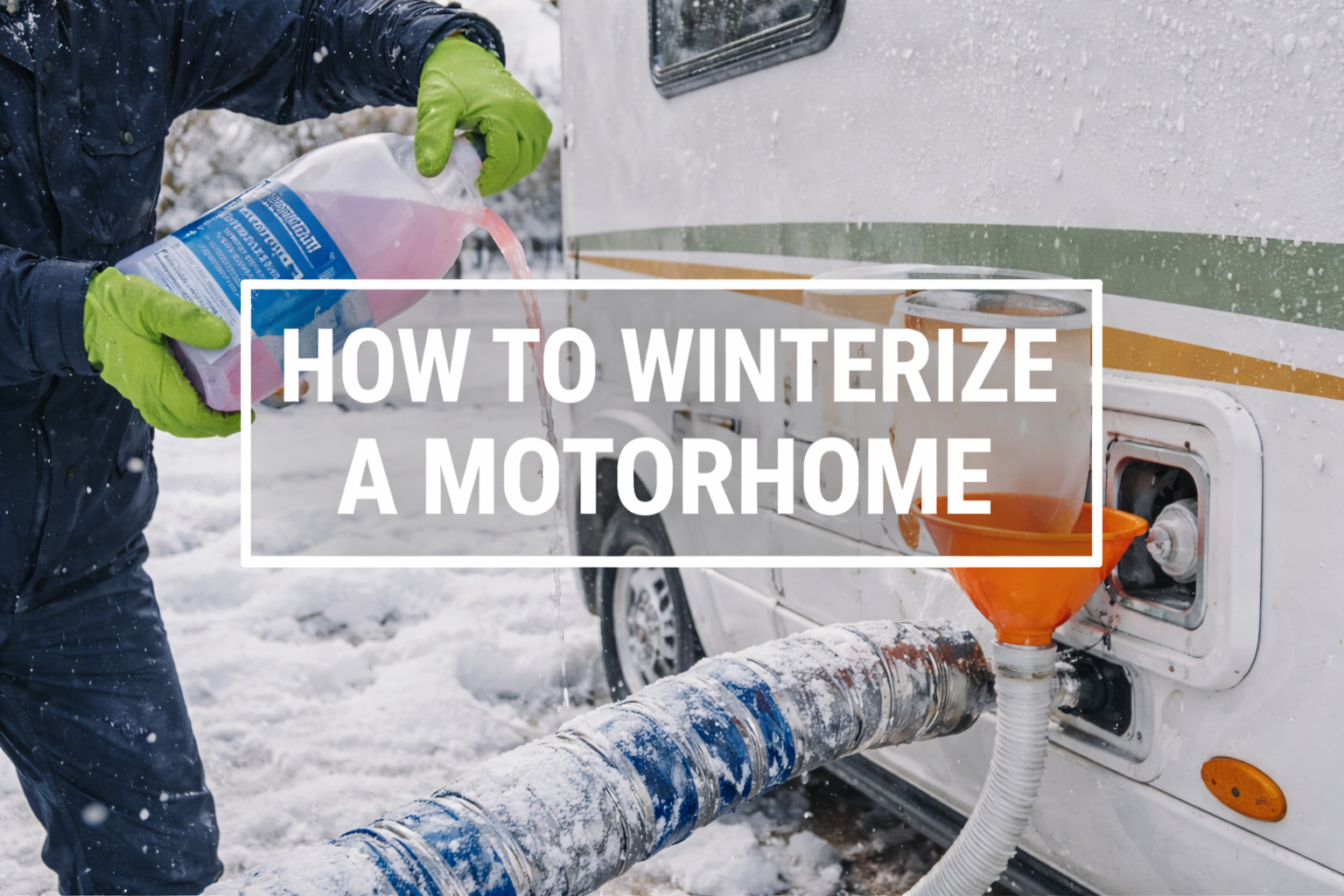
- Circulate propylene-glycol (PG) RV antifreeze through fixtures to protect every line and fitting.
- Protect vulnerable “small” areas like the flush button circuit, shower head hose, and flush water supply tank where water loves to hide.
- Remove filters and protect housings so carbon filter housings and cartridges don’t crack or harbour bacteria during prolonged inactivity.
- Service the toilet system and waste tanks to protect seals, prevent odors, and reduce water ingress and mould growth until spring.
How Do You Drain the Fresh Water Tank and Open All Faucets?
Draining the fresh water tank is the foundation of winterising because it removes most wash water before you clear the lines. Here’s how to do it cleanly and safely in 8 steps.
- Park on leveling ramps so gravity helps purge the dregs.
- Wear gloves and position a container or hose under the drain valve or drain tap.
- Open the drain valve/tap fully and let the tank empty completely.
- Open all interior faucets to vent the system.
- Set mixer taps to the mid-position so both hot and cold sides vent at the same time.
- Briefly run the pump until the system goes dry, then stop quickly to avoid pump burnout.
- Leave taps open through storage so air can move naturally through the system.
- Drain shower points properly: remove the shower head, hang the hose so water drains freely, and open the external shower point near the side panel.
How Do You Blow Out Water Lines With Compressed Air?
Blowing out the water lines clears residual water pockets that remain after draining. Do it in a controlled order so you don’t miss lines feeding the toilet cassette or flush button circuit, and keep pressures safe.
Follow these 8 steps.
- Fit a blow-out plug to the city-water inlet.
- Connect to a compressor and regulate pressure to 20–30 PSI before you start.
- Begin at the lowest outlets closest to the pump so you clear the easiest drains first.
- Progress to higher fixtures as the system dries out.
- Cycle each faucet through hot and cold so both sides of every mixer clear fully.
- Include toilet-related lines so the toilet cassette feed and flush button circuit are cleared, not just the sinks and shower.
- Open low-point drains until only air exits, then close them once the flow is dry air.
- Never exceed 50–60 PSI because over-pressurizing can crack fittings and stress appliances like a Truma Ultrastore boiler or hydronic coil system—those units are best protected with antifreeze circulation rather than air alone.
Do You Need to Bypass the Water Heater Before winterising Lines?
Yes. You must bypass the water heater before pushing antifreeze through the water system, or you will waste propylene glycol and create extra spring flushing work. Use this 7-step sequence.
- Engage a bypass kit so flow routes directly into the hot circuit instead of filling the heater.
- Avoid wasting antifreeze because some heaters can hold up to 30 liters, and filling that volume wastes costly PG.
- Know your drain design: some heaters (Truma Ultrastore boiler or Carver boiler) have automatic dump valves that release water around 41 °F, while others use manual drain valves.
Let the heater cool before you open anything. - Relieve pressure by opening the P&T valve carefully after the system is safe to work on.
- Remove the anode or drain plug (or open the manual drain valve) to empty the tank fully.
- Leave the bypass set so antifreeze protects the system without filling the heater, and so residual water can’t freeze and crack fittings during prolonged inactivity.
How Do You Add RV Antifreeze to Lines, Traps, and Fixtures?
RV antifreeze is a non-toxic propylene glycol solution that slushes without expanding, so it protects potable water lines without freeze-burst damage.
Use this method in 10 steps to reach every fixture, trap, and toilet component:
- Use RV antifreeze (propylene glycol) and keep it non-toxic and potable-system safe.
- Disconnect the pump inlet so you can feed antifreeze directly into the pump.
- Insert a short pickup hose into the PG container.
- Run the pump until pink appears at the first fixture to confirm the system is drawing antifreeze.
- Start with cold, then move to hot at each outlet so both sides of the mixer fill with PG.
- Work systematically through fixtures: sinks first, then the shower head, then the outside shower.
- Finish with the toilet system so the toilet supply lines, cassette feed, and connected circuits receive PG.
- Dose every P-trap with 1 to 2 cups so traps don’t freeze and stink or dry out.
- Protect the toilet cassette tank and bowl: flush about two cups into the toilet cassette tank, then leave another cup in the bowl to protect the seal.
- Don’t miss small connected components like the flush button and flush water supply tank (if connected to the main water system), estimate volume correctly (often two gallons for small RVs, four to five gallons for larger Class A units with washers/dishwashers, plus extra per appliance), and never dilute PG because weakening it reduces freeze-burst protection.
What Should You Do With Water Filters Before Winter Storage?
Filters and housings are easy to overlook, but they can crack or harbour bacteria if left damp, contaminating the entire water system when spring arrives. Remove and store them correctly in 8 steps.
- Remove water filters before winter storage so cartridges and housings don’t crack.
- Take out carbon filter elements completely.
- Remove UV cartridges if your system uses them.
- Remove inline filters connected to the water tank or system.
- Drain filter housings fully so no residual water sits in the bowls.
- Label each filter with flow direction and installation date so spring reassembly is simple and correct.
- Store filters indoors in sealed plastic bags in a dry area above freezing to preserve cartridge life.
- Clean mesh pump grit screens while the system is dry (they don’t typically trap residual water, but they still benefit from a clean-out).
How Do You Winterise the Water Heater Safely?
Winterising the water heater means draining it completely and bypassing it so antifreeze never enters the tank.
This is essential because filling a Truma Ultrastore boiler, a Carver boiler, or any six-gallon unit with propylene glycol wastes up to 30 liters unnecessarily and complicates your spring setup.
There are seven steps to winterise your water heater safely:
- Switch off all power sources to the heater — electric, gas, and any hydronic connections.
- Allow the unit to cool completely before touching any valves or fittings.
- Open a hot tap inside the motorhome to let cold water replace hot, reducing pressure across the water system.
- Carefully lift the P&T relief valve at the heater to release any remaining internal pressure.
- Remove the anode rod or drain plug and allow all residual water to drain out completely.
- Engage the bypass kit to route flow directly to the hot circuit, keeping propylene glycol out of the tank entirely.
- Leave the drain port open during prolonged inactivity so the interior dries fully. For tankless or hydronic systems, circulate antifreeze through the coils — air alone will not clear them.
How Should You Prepare Cassette Toilets and Black/Gray Waste Tanks?
Preparing your waste tanks and cassette toilet ensures seals stay flexible and odors stay controlled throughout the entire storage period. Left untreated, dried seals crack, valves stick, and odors become very difficult to clear come spring.
Follow these 9 steps for cassette toilets and black/gray tanks.
- Empty the black tank first so solids clear properly.
- Empty the gray tank second so gray wash water flushes the outlet.
Rinse the toilet cassette thoroughly after emptying. - Use a warm tank-cleaner solution to clean the cassette interior.
Drain through the valve so the cassette clears fully. - Lubricate the blade seal with a wipe of olive oil or a purpose-made spray to prevent sticking.
- Leave all valves closed after cleaning to stop backflow or water ingress.
- Add propylene glycol to protect seals: add one to two cups into the tanks, and pour another cup into the bowl to protect the seal during prolonged inactivity.
- Handle the cassette blade correctly: leaving the blade cracked slightly during drying helps prevent sticking, but close it for long-term storage.
What Common Mistakes Should You Avoid When Adding RV Antifreeze?
What Common Mistakes Should You Avoid When Adding RV Antifreeze? Even when you follow the correct sequence, small oversights can leave parts of your water system exposed to freeze damage. These mistakes are easy to make and costly to fix, so knowing them before you start protects your motorhome and your wallet.
Avoid these 9 common mistakes so you don’t crack fittings, dry seals, or contaminate your potable system.
- Don’t dilute propylene glycol because it reduces freeze-burst protection.
- Don’t forget the outside shower head or the external shower point near the side panel.
- Don’t skip the flush button circuit and any toilet cassette feed lines that hold water pockets.
- Don’t miss ice-maker loops and appliance runs like washers or dishwashers in larger Class A units.
- Don’t over-pressurize during blow-out—pressures above 50–60 PSI can damage fittings and sensitive appliances.
- Don’t fail to bypass the heater or you can waste 30 liters of antifreeze and face a long spring flush.
- Don’t neglect P-traps and the toilet system because dry seals lead to leaks and odors.
- Don’t miss low-point drains because residual water pockets freeze and crack fittings.
- Never use automotive antifreeze because it contaminates potable water lines.
How Do You Winterise a Motorhome for Storage (Beyond the Water System)?
Winterising beyond plumbing addresses fuel, batteries, seals, tires, interior, and security. These steps protect against mould growth, water ingress, and mechanical wear. There are ten important steps to follow:
- Gas and Propane: Close cylinder valves, disconnect regulators, and cap pipework. Store cylinders upright in a ventilated space if required. Propane is more reliable in winter, but bottles must always be shut off.
- Engine and Fluids: Fill the fuel tank to limit condensation. Check coolant protection to −10 to −15 °C and top washer fluid with antifreeze.
- Batteries and Electrical Equipment: Maintain the leisure battery with mains power float charging every few weeks. If off-site, remove and store warm, or fit solar panels ≥40 W.
- Exterior and Seals: Wash, wax, and inspect for cracks. Fit a breathable cover to prevent water ingress; never use a tarp.
- Tires and Chassis: Inflate to specification or slightly higher. Leave the handbrake off, chock wheels, and rotate 90–120° time to time. Fit winter tyres or a tyre chain if planning cold-weather use.
- Interior and Odor Control: Remove food, stand soft furnishing cushions upright, and allow a steady flow of air. Use anti-damp crystals or a dehumidifier if mains power is available.
- Fridge and Freezer: Clean thoroughly, remove shelves, and prop doors open to prevent mould growth.
- Security: Install a Sold Secure steering wheel lock, consider alarms or trackers, and shut blinds to reduce visibility.
- Storage Site: Choose hard standing at a managed site such as Green Hill Farm Caravan and Camping Park. Ensure vermin control and CCTV if possible.
- Monthly Checks: Visit the motorhome from time to time to check the drain valve, battery charge, seals, and for signs of mould or pests.
How Do You Secure and Shut Down the Gas/Propane System?
Winterising the gas system prevents leaks and ensures safety during prolonged inactivity. Follow these 7 steps to close, isolate, check, and protect the gas/propane setup properly.
- Close all cylinder valves completely. Turn each valve fully off so no gas can flow during storage.
- Disconnect clip-on regulators. Remove regulators cleanly so fittings are not left under strain.
- Cap open pipework. Cap any open ends to avoid water ingress or dirt getting into the system.
- Remove cylinders if site rules require it. If required, take cylinders out and prepare them for safe storage.
- Store removed cylinders upright in a ventilated location. Keep them stable, upright, and in a place with good airflow.
Isolate onboard tanks using their dedicated shut-off valves. If your motorhome has an onboard tank, shut it off at the tank valve. - Do a final leak check and protect appliance vents. Use soapy water on connections before leaving the vehicle, then cover appliance intake and exhaust vents to deter pests and weather. Although propane is preferable for cold-weather camping, cylinders must always remain shut during storage.
How Do You Protect the Engine and Vehicle Fluids for Winter?
Protecting the engine and vehicle fluids reduces wear, prevents freeze damage, and improves reliability when you return. Use these 7 steps to keep fluids stable and avoid cold-weather issues.
- Verify coolant strength. Confirm coolant protects down to −10 to −15 °C.
- Replace engine oil if a service is due. Do it before storage so contaminants don’t sit in the engine.
- Fill the fuel tank fully. A full tank helps minimize condensation.
- Add fuel stabilizer if storage exceeds six months. Stabilizer matters most when you expect prolonged inactivity.
- Top the washer reservoir with antifreeze-rated wash water. This prevents line cracking in freezing conditions.
- Keep diesel exhaust fluid (DEF) fresh. DEF can degrade in cold, so avoid storing old or questionable fluid.
Avoid idling and drive monthly instead. Once a month, drive 20–60 minutes on a dry day to reach full operating temperature. This cycles the A/C, clutch, and brakes while reducing mould growth and preventing water ingress.
How Do You Maintain and Store Leisure/House Batteries Over Winter?
Maintaining the leisure battery prevents sulfation and keeps your electrical equipment ready for spring. Use these 7 steps to keep state of charge healthy and protect LiFePO₄ batteries correctly.
- Choose a storage method. Use one of these options: float charge with mains power, remove the battery for warm indoor storage, or maintain it with a solar panel.
- If using mains, leave the battery on float charge. Use a proper smart charger so it maintains safely.
- If removing the battery, store it warm indoors. Warm, dry storage slows self-discharge and reduces stress.
- If using solar, use at least a 40 W panel. This helps maintain charge during prolonged inactivity.
- Keep state of charge above 80 percent. Aim high and never let voltage drop below 12.0 V.
- Handle LiFePO₄ batteries carefully in cold. They cannot be charged below 0 °C; warm the cells first or rely on built-in heaters.
- If site rules forbid removal, cycle charge another way. At places like Green Hill Farm Caravan and Camping Park, drive the motorhome for two to three hours every few weeks, or connect a smart trickle charger from time to time.
How Do You Protect the Exterior, Roof Seals, and Tires During Storage?
Exterior care prevents water ingress, limits mould growth, and reduces wear from UV and static loads. Follow these 9 steps to protect the body, roof seals, and tires through winter.
- Wash the motorhome fully. Remove road grime and salt before it sits for months.
- Apply a protective wax coat across the body and roof. This barrier limits water ingress and reduces mould growth.
- Inspect sealant around joints, rooflights, and windows. Look for cracks and weak seams.
- Refresh any damaged sealant. Cracked seams let residual water seep inside during freeze-thaw cycles.
- Fit a breathable cover once the exterior is clean. Choose one with a soft underside to protect paintwork and soft furnishing from UV damage.
- Fit the cover to allow the flow of air. Airflow helps prevent condensation and moisture build-up.
- Inflate tires correctly. Inflate to specification or raise pressure by 3–5 PSI above factory recommendation.
- Release the handbrake and secure with chocks. This helps prevent binding while keeping the vehicle stable.
- Reduce flat spots and UV cracking. Rotate tire positions halfway through winter, and use wheel covers or indoor storage for extra protection against winter tyre stress and UV cracking.
Should You Use a Breathable Cover or Store Indoors?
Indoor storage offers the best protection, keeping the bodywork and seals safe from freeze-thaw cycles, water ingress, and UV.
If you must store outdoors, always use a breathable cover with a soft lining, fitted tightly to avoid chafing during wind.
Avoid tarpaulins, since they trap moisture and accelerate mould growth.
Before covering, clean and dry the motorhome thoroughly, including the roof and underbody. By doing so, you minimize long-term surface damage and keep the exterior fresh when you return to it frequently.
How Do You Inspect and Maintain Roof and Window Seals?
Roof and window seals are common points of water ingress, so you need a simple routine during storage. Follow these 5 steps every few months to keep seals sound.
- Inspect every few months during storage. Regular checks prevent small cracks becoming leaks.
- Walk the perimeter of the roof. Check around vents, joints, and rooflights closely.
- Look for hairline cracks or peeling sealant. These are early signs of future water ingress.
- Clean the surfaces with mild wash water. Clean surfaces help sealant bond properly.
- Reseal with RV-compatible sealants and protect exposed vents. Reseal where needed, and in exposed sites fit winter covers over fridge vents to block debris and improve insulation.
How Do You Care for Tyres and Wheels in Long-Term Storage?
Tires carry static loads for months, which increases flat-spotting and cracking risk. Use these 6 steps to keep tyres and wheels healthy.
- Plan for static-load stress. Long storage increases the risk of flat-spotting and cracking.
- Inflate to spec or slightly higher. Inflate to the recommended specification or about 3–5 PSI higher.
- Cover tyres with UV shields. UV protection reduces sunlight damage and cracking.
- Raise or rotate mid-season if allowed. Use approved jacks, or rotate the wheels 90–120 degrees mid-season.
- Use leveling blocks and chocks, and leave the handbrake off. This distributes weight and helps prevent binding.
- Replace tyres on age, not just tread. Even with good tread, plan replacement every five to six years, since rubber hardens with age.
How Should You Clean the Interior and Refrigerator/Freezer Before Storage?
Interior cleaning prevents mould growth, protects the water system, and keeps the motorhome fresh. Follow these 8 steps to clean, sanitize, ventilate, and block pests properly.
- Remove all food. Clear cupboards, the flush water supply tank area, and the refrigerator.
- Sanitize the fresh water tank. Use one cup of bleach per fifty liters.
- Rinse thoroughly through the system. Run clean water through every drain tap and the flush button circuit until fully clear.
- Wipe down interior surfaces. Clean shelves, drawers, and the shower head with mild wash water.
- Prop fridge and freezer doors open. This prevents stale smells and mould.
- Remove fridge shelves for airflow. Open space improves the flow of air through the appliance.
- Ventilate soft furnishing. Stand cushions and other soft furnishing on edge to reduce moisture build-up.
- Control damp and block pests. Use anti-damp crystals or a small dehumidifier if mains power is available, then fit mesh over vents and entry points to protect systems like the toilet cassette and carbon filter.
How Should You Clean and Protect the Exterior Before Storage?
A proper exterior clean reduces corrosion risk and helps prevent water ingress and mould growth later. Use these 6 steps to wash, protect, and lubricate key areas.
- Wash top-down thoroughly. Use degreaser on stubborn marks.
- Rinse the underbody. Pay extra attention if you’ve driven on salted winter roads.
- Apply a high-quality wax or seasonal protector. This creates a barrier against weathering and mould growth.
- Focus on detail zones. Clean seams, lights, and areas around the drain valve where dirt gets trapped.
- Lubricate locks and hinges. Lubricate door locks and apply silicone to hinges for smooth function.
- Protect rubber window seals correctly. Use a light coat of silicone grease or talc, and avoid petroleum-based products that can degrade the material.
Where Should You Store a Motorhome Over Winter?
The best option for winter storage is an indoor, climate-controlled facility that protects against water ingress, UV exposure, and mould growth.
If this isn’t available, a covered or hard-standing site with CCTV, vermin control, and sold secure access provides good protection.
A breathable cover adds extra defense in outdoor settings, but always clean and dry the motorhome first.
On-driveway storage is the most convenient, offering easy access to the fuel tank, leisure battery, and electrical equipment.
However, it requires visible deterrents like a steering wheel lock and ideally access to mains power for battery float charging.
Regardless of where you store, look for a site that allows regular checks, lets you rotate winter tyr and tyre chain–ready wheels, and ensures a stable flow of air.
How Do You Deter Theft and Improve Security During Winter Storage?
Security is about deterrence first, then recovery if the worst happens. Use these 6 steps to make your motorhome harder to steal and easier to recover.
- Use visible deterrents. Fit a steering wheel lock, wheel clamps, and upgraded door and window locks.
- Add alarms and discreet trackers. These improve detection and recovery if stolen.
- Remove all valuables. Take out valuables and small electrical equipment.
- Leave cupboards open. This shows there is nothing inside worth stealing.
- Record appliance serial numbers. Record serial numbers of major appliances like the Truma ultrastore boiler or carver boiler.
- Improve recovery and storage standards. Consider after-theft recovery systems and store the motorhome on a Sold Secure facility if possible.
How Often Should You Check on a Stored Motorhome During Winter?
You should check on your stored motorhome about once a month, even under a breathable cover or in an indoor facility.
A regular visit allows you to run through a quick checklist that prevents small issues from becoming major problems.
- Check the leisure battery charge level, top it up with mains power if available, and ensure the fuel tank remains stable.
- Look for signs of damp or mould growth around seals, soft furnishing, and cupboards. Inspect the water system for leaks or residual water near a drain valve or drain tap.
- Test tire pressures on your winter tyre or tyre chain–ready wheels, and confirm the cover is secure with no chafing.
- Walk around to spot pest activity or water ingress, and check locks and alarms for proper function.
How Do You Winterise a Motorhome for Living in It All Season?
Living in your motorhome through the cold months requires a different strategy than simple storage. Instead of draining and shutting down, you adapt the water system, heating, and structure to withstand prolonged inactivity outdoors while keeping the inside comfortable. There are 8 steps to follow, and each one directly protects your investment, safety, and daily comfort.
1. Insulation
Fit thermal window covers, foam inserts in roof vents, and insulated mats. Skirt the base to block drafts and lift tanks off metal floors with foam to prevent heat loss. Plug floor gaps to minimize conduction and reduce condensation.
2. Heating Selection
Match heat source to your power supply. Diesel heaters give efficient dry warmth, propane is convenient but adds humidity, and electric works well when mains power is available. Always run with CO and smoke detectors active.
3. Plumbing Freeze Protection
Keep interior at least 10 °C when away. Use heated hoses, 12 V pads for underslung water tanks, and wrap drain valves. This prevents residual water from freezing in exposed lines.
4. Moisture and Ventilation
Stand soft furnishing cushions upright, use anti-damp crystals, and ensure steady flow of air. Ventilation avoids mould growth and reduces water ingress around seals.
5. Power Strategy
Keep the leisure battery charged. Use a smart charger on mains power or solar panels of at least 40 W. Never allow voltage to drop below 12.0 V.
6. Tires and Traction
Fit winter tyr if traveling, carry a tyre chain set, and rotate tire position time to time during long stays. Maintain pressure slightly above spec to prevent flat spots.
7. Safety Monitors
Install carbon monoxide alarms and test electrical equipment. Check gas detectors and ensure a fire extinguisher is in date and accessible.
8. Snow and Access Routines
Clear roof weight promptly to avoid stress on seals. Keep paths to doors free and accessible, and use olive oil on rubber seals to prevent sticking in freezing conditions.
How Do You Insulate and Eliminate Thermal Bridges Inside a Motorhome?
Insulating properly means stopping heat from escaping through weak points, often called thermal bridges. Here are 6 steps to reduce heat loss, cut drafts, and control condensation using practical, inside-the-van fixes.
- Start with reflective window covers.
Fit reflective window covers on cab and habitation windows to reduce condensation and trap warmth. - Block roof-vent heat loss.
Add foam inserts to roof vents so warm air doesn’t bleed out through the largest openings overhead. - Insulate the floor where cold creeps in.
Lay insulated mats across floors, especially around drain valves and mains power access points where cold bridging is common. - Fit skirting to stop lower-body drafts.
Add skirting along the lower body to block cold drafts and maintain stable wash water temperatures. - Break the metal-floor conduction path under tanks and pipes.
Pay special attention to tanks and pipes that sit on metal floors. Raise them on foam blocks to cut conduction. - Seal the small gaps that leak heat.
Seal even small gaps around the drain tap or fuel tank area so cold air can’t sneak in and create hidden thermal bridges.
Which Heating Options Work Best for Winter Living (Diesel, Propane, Electric)?
The best heating option depends on your setup and whether mains power is consistently available.
Electric heaters work well if you’re plugged into shore power at a facility like green hill farm caravan and camping park, but they demand careful load management with other electrical equipment.
Diesel heating provides efficient, dry warmth and is ideal when you want to reduce interior humidity, though installation can be more complex.
Propane offers convenient heat through systems like a Truma ultrastore boiler or carver boiler, but it adds moisture to the air, requiring extra ventilation to maintain healthy flow of air.
No matter the fuel source, you must install and regularly test carbon monoxide and smoke detectors.
Keeping a backup method, such as a small electric heater or portable diesel unit, ensures redundancy and comfort even during prolonged inactivity in freezing weather.
How Do You Adapt the Plumbing for All-Season Use (Heated Hoses, Tank Heaters)?
All-season plumbing is about keeping water moving and protecting the vulnerable points that freeze first. Here are 6 steps to keep your flush water supply tank, tanks, lines, and valves safe in deep cold.
- Use heated hoses to stop supply-side freezing: Heated hoses ensure your flush water supply tank stays liquid even during prolonged inactivity.
- Add 12 V heating pads to the tanks: Use 12 V heating pads on the water tank and gray/black tanks to guard against ice buildup.
- Insulate exposed lines before they become a problem: Insulate exposed lines so the cold can’t attack the pipe runs and fittings.
- Protect the drain valve and drain tap with foam: Add foam around the drain valve and drain tap because these points freeze early and can crack or jam.
- Shield boiler fittings and sensitive connections: Protect fittings on the Truma ultrastore boiler or carver boiler so seals and joints don’t suffer in freezing conditions.
- Keep bays gently warm and avoid open-valve freeze traps: Keep utility bays slightly warmed with a small thermostatically controlled heater, consider recirculation pumps to prevent residual water from stagnating in pipes, and always leave gray valves closed unless draining to an external container during deep cold (open valves encourage water ingress and blockages).
How Do You Manage Moisture, Condensation, and Mould in Winter?
Managing interior humidity is essential to prevent mould growth, protect soft furnishing, and stop water ingress from damaging the structure. Here are 6 steps to keep relative humidity stable while maintaining a steady flow of air.
- Target the right humidity range.
Aim to keep relative humidity between 40–50% while balancing heat with steady flow of air. - Create a simple ventilation path.
Open a roof vent slightly and a low floor vent to promote natural circulation from floor to ceiling. - Use mains-powered dehumidification carefully.
If you have mains power, run a dehumidifier time to time, but never seal the cabin completely, because trapped moisture damages woodwork and electrical equipment. - Add passive moisture control for backup.
Use anti-damp crystals or refillable moisture absorbers as extra defense during prolonged inactivity. - Stop soft furnishing from becoming a cold sponge.
Lift cushions, stand them upright, and cover with a breathable cover to reduce condensation on contact surfaces. - Control cooking moisture at the source.
If cooking inside, use a carbon filter in the galley vent and run the fan so moisture doesn’t settle into cupboards and corners.
How Should You Ventilate Effectively in Winter?
Effective ventilation keeps a continuous flow of air moving through the motorhome, so condensation and mould don’t build up on soft furnishing, seals, and inside cupboards. Here are 5 steps to ventilate safely without losing control of warmth.
- Keep all gas drop vents clear and never tape them off, even in freezing conditions. These are safety-critical and blocking them puts you at risk.
- Run a roof fan on low duty continuously. This provides constant air movement without the heat loss that comes from opening vents fully.
- Purge the entire cabin periodically by running the roof fan at higher speed for a short burst. This refreshes stale, moisture-laden air quickly and efficiently.
- Combine the roof fan with a low floor vent to balance warm and cold air layers. This protects your water system and electrical equipment from hidden moisture damage working its way up from below.
- Maintain controlled ventilation even when the motorhome is under a breathable cover during prolonged inactivity. Without it, even a breathable cover cannot stop water ingress from becoming a structural problem.
Do Vapour Barriers Help Inside a Motorhome?
Vapour barriers can help in very cold storage, but only when applied as a continuous, properly sealed layer on the warm side of the insulation.
If poorly installed, they trap residual water and condensation against cold skins, accelerating mould growth and water ingress.
In practice, most motorhomes already rely on targeted insulation rather than full vapor-sealed assemblies.
You should only consider them when re-lining walls or floors, using compatible materials that allow safe flow of air around fixtures such as the Truma ultrastore boiler, carver boiler, and flush water supply tank.
When Should You Use a Dehumidifier in a Motorhome?
A dehumidifier is best used as a temporary control method when you have reliable mains power and want to lower humidity quickly.
You should always combine gentle background heat with dehumidification to prevent cold surfaces from causing recurring condensation.
Empty the water tank of the dehumidifier daily and ensure the drain tap or hose directs collected wash water safely.
For periods of prolonged inactivity, desiccant crystals or small moisture absorbers are more practical, especially when you cannot monitor the system at green hill farm caravan and camping park or another storage site.
How Do You Manage Batteries, Solar, and Electrical Loads in Extreme Cold?
Managing your batteries, solar input, and electrical loads in extreme cold requires careful planning to avoid permanent damage and unexpected power loss. There are 5 steps to keep your power strategy balanced and your batteries healthy through winter.
- Never charge a leisure battery, especially LiFePO₄, below 0 °C unless it has internal heaters or has been pre-warmed first. Cold charging causes permanent damage that cannot be reversed.
- Budget for shorter daylight hours and weaker PV output. Reduced solar gain in winter means mains power or a generator may be necessary as a backup power source.
- When using a generator at green hill farm caravan and camping park or other sites, follow proper site etiquette. Keep run times short and noise low to respect other guests.
- Prioritize essential electrical loads and postpone non-critical use of the shower head or wash water pumps. This keeps your drain on reserves manageable during long cold spells.
- Rotate your charging methods regularly to keep the drain valve of your power strategy balanced. This keeps your batteries healthy through prolonged inactivity and prevents deep discharge.
What Tyre Upgrades and Traction Gear Help for Winter Driving?
Winter safety starts with proper traction. You should always fit winter tyr for snow regions, as they remain flexible in sub-freezing temperatures and shorten braking distances.
- A dedicated second wheel set makes seasonal swaps easier and prolongs tread life.
- Carry essential gear: a tyre chain set matched to your wheel size, traction boards to free the vehicle from icy ruts, and a compact shovel for clearing snow around the fuel tank or underbody.
- Keep your towing eye and jack accessible, not buried under soft furnishing or stored deep behind the toilet cassette.
- Regularly check pressures, as cold reduces PSI, and inflate to recommended levels.
What Safety Accessories Should Be Prioritized (CO/Smoke Detectors, Monitors)?
Living in a motorhome through winter increases reliance on heating appliances, making detectors essential.
- You should always install a CO detector and a smoke alarm, tested monthly with the flush button, and replace batteries frequently.
- An LPG or flammable-gas detector adds protection around the Truma ultrastore boiler, carver boiler, and fuel tank regulators. Pair these with a compact fire extinguisher and a fire blanket stored within arm’s reach of the kitchen and toilet system.
- Keep spare batteries ready, even if mains power is available, so detectors stay active during outages. With these measures, you reduce risks of water ingress, mould growth, or electrical equipment faults escalating into emergencies.
How Do You Clear Snow Safely and Get Unstuck?
Snow buildup can strain the roof, block vents, bury critical parts, and trap you on site, so you need a safe, methodical approach. Here are 7 steps to clear snow without damage and improve traction if you get stuck.
- Start with the roof load problem: Treat snow management as vital when living in a motorhome through winter, because buildup can strain the roof and trap you on site.
- Use the right tool on sensitive surfaces:Use a long-handle snow broom to clear panels, vents, and solar without damaging seals.
- Protect appliance outlets while clearing: Clear around the Truma ultrastore boiler flue carefully so it stays unobstructed.
- Use safe access every time you climb: Always climb a ladder safely. Wear winter tyr boots with good grip before stepping up or working around icy edges.
- Dig out the running gear, not just the door area: Around the axles, shovel drifts away to reduce resistance and improve your chances of moving off.
- Check buried valves and taps before they freeze in place: Make sure the drain valve or drain tap is not buried under snow.
- Escalate traction support in a controlled way: If traction fails, deploy tyre chain sets or traction boards beneath the drive wheels. Keep a compact shovel ready for emergencies. If conditions are unsafe, the safest option is to wait out heavy storms at green hill farm caravan and camping park (or another secure location) until roads are cleared.
Where Can You Store Skis and Wet Gear in a Small Space?
Skis, boots, and wet gear require careful planning to avoid water ingress and mould growth inside the motorhome.
- You can mount a rear-door storage box to keep skis outside the living area, leaving the soft furnishing safe from drips.
- The shower head area doubles as a drying cabinet when fitted with drip trays or tubs beneath boots.
- Modular bins and stackable crates keep gloves, helmets, and poles organized.
- Ideally, create a wet zone near the entry, with mats to capture wash water before it spreads.
How Do You Manage Wet Clothes and Shoes Inside?
Wet gear inside a motorhome quickly creates damp, smells, and mould, so you need dedicated drying and drip control zones. Here are 6 steps to dry clothes, protect soft furnishings, and stop wash water spreading into sensitive areas.
- Treat wet gear as a mould-control issue: Managing wet clothes and shoes indoors prevents mould growth, damp odors, and premature wear on fabrics.
- Install drying where warm air actually moves: Install a ceiling-mounted drying line so you can hang clothes where a warm flow of air circulates.
- Power the airflow with what you have: Support that airflow using a diesel heater or a mains power fan, depending on what your setup allows.
- Protect soft furnishings before they get soaked: Cover seats and cushions with a breathable cover or light plastic sheets, so residual water does not soak into the soft furnishing.
- Create a drip zone at the door: Near the entry door, place dedicated drip mats or trays for boots and shoes, catching wash water before it reaches the leisure battery compartment or toilet system.
- Finish drying with gentle, dry heat: Accelerate drying with gentle, dry heat from the carver boiler or an electric heater, so you dry gear without turning the interior into a damp box.
What Small Comforts Improve Winter Life on Board?
Daily life in a motorhome feels warmer when you add small comforts that reduce heat loss and improve mood.
- Thick rugs insulate floors against cold conduction, while slippers and warm blankets keep you cozy on soft furnishing.
- Thermal curtains or window film reduce water ingress from condensation, especially near the wash water system or flush water supply tank.
- Hot-water bottles provide targeted warmth, while insulated mugs keep drinks hot when the flow of air inside is chilly.
- Switching to low-glare lighting helps your eyes adjust to long nights, creating a calm environment during prolonged inactivity.
Which Is Better for Winterising Water Lines — RV Antifreeze or Compressed Air?
RV antifreeze generally provides the most reliable freeze-burst protection, while compressed air offers convenience in spring but leaves pockets of residual water if not done perfectly.
Both methods aim to protect your water system from freeze damage, but their suitability depends on your climate, setup, and personal preference.
Propylene glycol (PG) antifreeze, rated to −25 to −50 °F, ensures fixtures, the flush water supply tank, and toilet system remain safe through prolonged inactivity.
You usually need 2–5 gallons for a typical motorhome, plus more if appliances like a dishwasher or clothes washer are connected.
A heater bypass saves about 30 liters, minimizing waste. Cleanup in spring involves flushing PG through taps and the shower head until wash water runs clear.
Compressed air uses 20–30 PSI (never exceed 50–60 PSI) to clear lines via a drain valve or drain tap. While quick and low-cost, it can miss low points in the water tank or leave moisture in fixtures. That’s why some owners choose a hybrid to blow out lines first, then protecting traps and fixtures with a gallon of PG antifreeze.
| Method | Protection Level | PSI/Rating | Volume Needed | Appliance Risk | Spring Clean-Up | Cost | Time | Typical Use Case |
| PG Antifreeze | High | −25/−50 °F | 2–5 gal (+1/major appl.) | Low | Moderate flush | Low–moderate | 1–2 h | Best for hard freezes |
| Compressed Air | Medium | 20–30 PSI | 0 gal | Higher on coils | Minimal flush | Very low | 0.5–1 h | Mild freezes/short lay-ups |
| Hybrid | High | Both | ~1–2 gal | Low | Low–moderate | Low–moderate | ~1–2 h | Balanced, popular approach |
What Tools and Supplies Are Required for Motorhome winterisation?
To protect your water tank, plumbing, and electrical equipment from winter damage, you need both specialized tools and general supplies. These items help you manage residual water, seal against water ingress, and prepare your motorhome for prolonged inactivity.
Here’s a comprehensive list of essentials:
- RV PG antifreeze: 2–5 gallons depending on your water system and appliances.
- Pump pickup hose or winterise kit: Allows direct antifreeze feed into the lines.
- Blowout plug: Connects an air compressor to the drain valve or drain tap.
- Air compressor: With regulator set at 20–30 PSI for safe line clearing.
- Deep socket wrench: To remove the heater anode or plug from the Truma ultrastore boiler or carver boiler.
- Personal protective equipment: Gloves and eye protection when handling fluids.
- Ramps and chocks: Stabilize the vehicle and relieve tire stress when using winter tyr or tyre chain.
- Sealant and silicone grease: Maintains roof joints, window seals, and shower head fittings.
- Anti-damp crystals: Reduce mould growth and protect soft furnishing.
- Wheel covers and breathable cover: Guard tires and bodywork during storage.
- Snow broom, shovel, traction boards, scraper, ladder: For snow and ice management.
- CO/smoke and gas detectors: Essential safety monitors with test flush button.
- Smart charger or trickle charger: Keeps the leisure battery healthy during downtime.
- Multimeter: For checking mains power connections and monitoring electrical loads.
How Much Does Motorhome Winterisation Cost?
In total, motorhome winterisation typically costs between £40 and £315+, depending on whether you choose a DIY approach or hire a professional service.
For DIY motorhome winterisation, you can expect to spend around £40–£80 for the essentials.
Propylene glycol antifreeze costs about £2.40–£4.75 per gallon, and you’ll usually need 2–5 gallons depending on the size of your water system and appliances like a flush water supply tank or toilet system.
Hoses, blowout plugs, and adapters range from £8–£24, while a smart charger for the leisure battery can add £20–£80.
Seasonal extras like a breathable cover range between £120–£315+, with optional tools such as a snow broom or tyre chain running £12–£160.
Small devices like CO or gas detectors cost £16–£48 each.
Professional winterisation can range from £120 to over £315 depending on labor time, location, and whether extras such as sealant work or mould growth prevention measures are included.
How Do You De-winterise a Motorhome in Spring?
De-winterising restores your motorhome’s systems after months of protection. The main steps involve flushing fluids, reconnecting parts, and checking safety systems. In total, there are nine essential steps to follow.
- Reconnect filters and shower head: Refit carbon filter cartridges, reconnect the shower hose, and check fittings.
- Fill and flush the water system: Run wash water through all taps until residual water and antifreeze are gone.
- Test all fixtures and pump: Operate the flush button on the toilet system, check the toilet cassette, and ensure flow of air in the Truma ultrastore boiler and carver boiler.
- Sanitize the water tank: Add a mild bleach solution, circulate, and rinse for safe drinking use.
- Close all drain valves and drain taps: Ensure no leaks remain open before pressurizing.
- Reset heater bypass and refit anode or plug: Secure the water heater for normal use.
- Pressurize and inspect for water ingress: Watch connections for drips or mould growth.
- Reinstall and charge the leisure battery: Use a smart charger or mains power.
- Check tires, fuel tank, and electrical equipment: Verify pressures, refill fluids, and confirm detectors work.
Can You Winterise a Sprinter-Based Motorhome Any Differently?
Yes. Although, winterising a Sprinter-based motorhome follows the same steps as any other platform, you need to account for a few unique details. Diesel engines require attention to the fuel tank and DEF system; DEF should be kept fresh, and prolonged idling should be avoided to prevent crystallization.
Tight service bays on Sprinter chassis can make access to the drain valve, drain tap, or under-seat leisure battery more challenging, so plan your work carefully.
Modern electrical equipment such as smart alternators and battery management systems also require consideration when connecting a smart charger to mains power.
You should insulate under-seat battery compartments and maintain steady flow of air in service bays to avoid water ingress or mould growth during prolonged inactivity.
Can You winterise a Motorhome Without Using RV Antifreeze?
Yes, you can winterise a motorhome without RV antifreeze by using compressed air to clear the water system, but this method has limitations.
By connecting a blowout plug to the drain valve and applying 20–30 PSI (never exceeding 50–60 PSI), you can force residual water out of lines, taps, and appliances.
This works best in mild climates where deep freezes are rare. However, antifreeze should still be poured into all drain traps, the toilet cassette, and seals in the toilet system to prevent freeze cracks.
A hybrid approach, which is air blowout plus a gallon of propylene glycol in key points offers safer coverage, reducing mould growth and protecting against water ingress during prolonged inactivity.
Can You winterise Your Motorhome Yourself or Should You Hire a Professional?
Yes, you can winterise your motorhome yourself if you follow a careful checklist, but hiring a professional offers peace of mind. DIY is cost-effective, with supplies like antifreeze, hoses, and a smart charger often totaling under $100. It also lets you learn about your own water tank, leisure battery, and electrical equipment.
However, mistakes such as leaving residual water in the flush button system or forgetting to close a drain tap can lead to expensive freeze damage.
Professionals, on the other hand, charge $150–$400, saving you time and reducing risk. Some owners also prefer pro service because a documented inspection may support warranty or insurance claims.
How Does Motorhome Winterisation Affect Motorhome Value?
Consistent winterisation directly influences motorhome value as it protects both mechanical systems and the interior environment, which translates into higher resale value.
When you keep detailed servicing logs and photos of your water system, fuel tank, and soft furnishing care, a buyer gains confidence that the vehicle was stored responsibly during prolonged inactivity.
Insurance providers also recognize that frost damage, mould growth, or water ingress are typically excluded, so documented preventive work lowers your risk of denied claims.
A motorhome that smells clean, has a stain-free ceiling, a healthy leisure battery, and a working flush button on the toilet system immediately signals proper care. Even a breathable cover or visible tyre chain in storage photos suggests diligence.
What Pro Tips and Common Mistakes Should You Avoid When Winterizing Your Motorhome?
Winterising your motorhome is as much about preventing mistakes as it is about taking the right steps. A few quick wins can save you from costly repairs later, while avoiding common pitfalls keeps your water system, fuel tank, and leisure battery in top shape during prolonged inactivity.
Quick wins:
- Label valves: Mark your drain valve, drain tap, and heater bypass clearly to avoid confusion in spring.
- Use a pump hose: A short pickup hose saves PG antifreeze and makes wash water flushing easier.
- Sticky notes: Place reminders near the outside shower head or flush button so you don’t miss hidden fixtures.
- Mesh on vents: Prevent pests and reduce water ingress while still allowing flow of air.
- Dashboard note: Remind yourself to reset pressures, wheel chocks, and the Truma ultrastore boiler bypass.
Pitfalls: Diluting antifreeze, over-pressurizing with compressed air, forgetting traps and the toilet cassette, sealing all vents (leading to mould growth), or leaving the handbrake on instead of chocking.
Never Dilute Antifreeze
RV antifreeze is designed to provide freeze-burst protection at its rated strength, often between −25 °F and −50 °F. If you dilute it with residual water from the water tank or lines, that protection is reduced, leaving your pipes, toilet system, or carver boiler vulnerable to damage.
A weakened mixture may slush sooner and expand, leading to cracks or water ingress in fittings.
You should always purge as much wash water as possible through the drain tap and drain valve before introducing antifreeze into the water system.
This ensures the PG solution reaches fixtures like the flush water supply tank, shower head, and toilet cassette at full concentration.
Skipping this step or adding plain water as a “top-up” undermines the entire winterisation process and risks expensive spring repairs.
Should You Pour Antifreeze Into Drains and Traps?
Yes, you should always pour antifreeze into every drain and trap, even if you blow out the water system with compressed air.
These low points naturally collect residual water, which can freeze, expand, and crack the plumbing.
For sinks, showers, and the toilet system, pour about half a cup (120 ml) into each P-trap or shower trap, making sure it flows into the bend where wash water normally sits.
Add enough to cover the seal in the toilet cassette and a small amount in the flush water supply tank if the carbon filter is removed.
This not only prevents ice damage but also keeps seals from drying out during prolonged inactivity.
How to Bypass the Pump and Heater Correctly?
Bypassing the pump and water heater is essential so you don’t waste gallons of antifreeze filling the Truma Ultrastore boiler or Carver boiler. The goal is to isolate the heater and draw antifreeze directly into the water system where it is actually needed. There are 6 clear steps to do this correctly and safely.
- Connect a siphon kit to the pump inlet: Install a quick siphon kit on the pump inlet so you can draw directly from an antifreeze jug. This prevents unnecessary dilution and keeps the process controlled.
- Set the bypass valves to isolate the heater: Adjust the bypass valves to route flow around the heater instead of through it. This isolates the Truma Ultrastore boiler or Carver boiler from the rest of the water system and keeps it empty.
- Open each faucet and the shower head: Turn on the pump and open every faucet one at a time. Include the shower head. Let the antifreeze run until pink fluid flows steadily from each outlet.
- Activate the toilet flush system: Press the flush button and run antifreeze through the flush water supply tank. This protects hidden circuits that often retain residual water.
- Close the drain valve and drain tap: Once pink fluid has circulated everywhere it should, close the drain valve and drain tap. This prevents residual water from re-entering the system.
- Perform a final circulation test: Turn the pump on briefly for a final check. Confirm that antifreeze circulates only through the intended lines and that the heater remains empty. This last test ensures the bypass is set correctly and the boiler is safely protected.
What Steps Are Commonly the Hardest—and How to Do Them Right?
Getting antifreeze to every line can be tricky because residual water pockets resist displacement.
The fix is to open each outlet one at a time, from the highest shower head down to the lowest drain tap, until the flow is fully pink.
Valve positions around the heater also confuse many; labeling them before storage saves you time to time.
Outside showers, carbon filter housings, and washer loops are easy to forget, yet leaving wash water in them risks water ingress and cracks.
A simple sticky note reminder on the dashboard helps prevent overlooked fixtures.
Even tasks like adjusting tire pressures or isolating the leisure battery become easier if you treat them as part of a checklist, not afterthoughts.
What Advanced Tricks Can Simplify winterisation?
A few advanced techniques can streamline the whole process.
- Use a short suction hose: Insert it directly into the antifreeze jug at the pump inlet, which reduces waste and speeds delivery.
- Label valve positions: Mark drain valve handles, bypass settings, and pump connections so you don’t second-guess next season.
- Protect vents with mesh: This prevents pests and ensures a steady flow of air during prolonged inactivity.
- Leave reminders: Place a steering wheel lock note to confirm tasks like securing the toilet cassette or draining the fuel tank stabilizer were done. These tricks may seem small, but they minimize confusion, save antifreeze, and reduce labour.
What Vulnerable Components Need Extra Protection?
Some parts of the motorhome are especially at risk from freezing or neglect:
- The outside shower head is often overlooked, but it contains residual water that can split fittings if not drained or filled with antifreeze.
- Filter housings and carbon filter cartridges need to be removed, dried, and stored separately to avoid mould growth.
- Appliances like ice makers, washers, or dishwashers have hidden loops where wash water lingers—these must receive antifreeze or be blown clear with compressed air.
- Even the toilet cassette seal should be lubricated lightly, sometimes with olive oil, to prevent cracking over prolonged inactivity.
How Long Does It Take to Winterise a Motorhome?
For most DIY owners, it takes about 2–4 hours to fully winterise a motorhome. Once you’ve practiced the process a few times, it often feels like “a few hours” of steady work rather than a long day.
The exact time depends on whether you simply drain the water system and pump antifreeze through the lines or add extra tasks like deep cleaning, inspecting seals for water ingress, or fitting a breathable cover.
Pros who service multiple vehicles regularly often complete the job more quickly, but even then, care is taken to check the drain valve, secure the toilet cassette, and disconnect the leisure battery from mains power.
If you add optional steps like treating soft furnishing or fitting tyre chain sets, expect the upper end of the timeframe.
Conclusion
winterising your motorhome only pays when you are consistent. With a simple checklist and just half a day’s effort, you can protect your water tank, drain tap, fuel tank, and even the soft furnishing that makes life on board comfortable. Doing this now saves you from frozen pipes, mould growth, dead leisure batteries, and other costly surprises when your motorhome sits in prolonged inactivity.
Whether you go with PG antifreeze, compressed air, or a mix of both, the trick is to match the method to your climate and double-check that every valve, shower head, and toilet system is covered. Add in smart habits, like fitting a breathable cover, keeping a steady flow of air, and caring for batteries, tires, and seals alongside the plumbing and you’ll not only avoid winter damage but also roll into spring with everything ready to go. It’s about peace of mind, value, and making sure you get to enjoy the road again without setbacks.
Frequently Asked Questions
Can You winterise a Motorhome Without Antifreeze?
Yes, you can winterise using only compressed air, though it is best suited to mild climates or short lay-ups. After draining the water tank and opening each drain tap, connect an air compressor set to 20–30 PSI to the city inlet. Re-open every faucet, shower head, and flush button until only air exits. This removes most residual water but can leave pockets in tankless heaters, coils, or the toilet system. For safety, still pour a small amount of PG antifreeze into each P-trap and toilet cassette seal.
Can I Camp In A winterised RV?
Yes. You can run it “dry” by carrying drinking jugs and using site facilities, or re-commission the water system if temperatures rise.
Do I Need To Run The Engine Monthly?
It’s better to drive until warm rather than idle. That keeps the fuel tank, battery, and electrical equipment healthier.
Do I Need to Fill the Heater with PG?
No. You bypass the Truma ultrastore boiler or carver boiler so antifreeze never fills them.
Is PG Safe?
Yes. Propylene glycol is non-toxic, but flush wash water lines and the flush water supply tank in spring to remove taste.